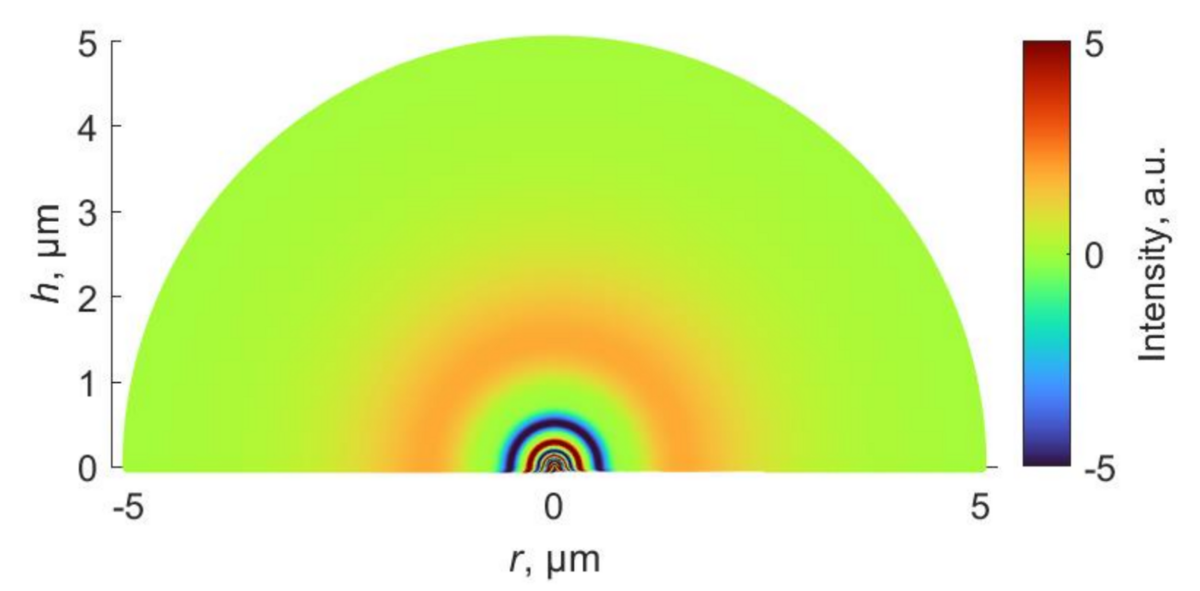
As quantum technologies advance, electron spin resonance (ESR) is becoming a valuable tool for spin-based quantum device development due to its ability to directly probe spin states. Such ESR measurements often require mK temperatures to minimize thermal noise, enhance spin polarization, and maintain long coherence times. At such low temperature, the spin-lattice relaxation time (\(T_1\)) increases significantly, making ESR experiments impractical. To address these challenges, superconducting microwave resonators with high Q-factors are often used. Such resonators amplify microwave magnetic field experienced by the spins, boosting the spin-resonator coupling. An increase in coupling strength leads to the Purcell relaxation effect, which significantly accelerates spin relaxation enabling ESR experiments [1].
In this work, the Bloch equations are solved for an inversion recovery pulse sequence, where spin relaxation is limited by the Purcell effect in the presence of a straight inductor of a superconducting microwave resonator. Therefore, the impact of spatially varying coupling and driving magnetic fields on spin relaxation can be analyzed. New insights into Purcell-limited spin relaxation in microresonator-based measurements are provided by this approach, and a foundation for further studies is established.