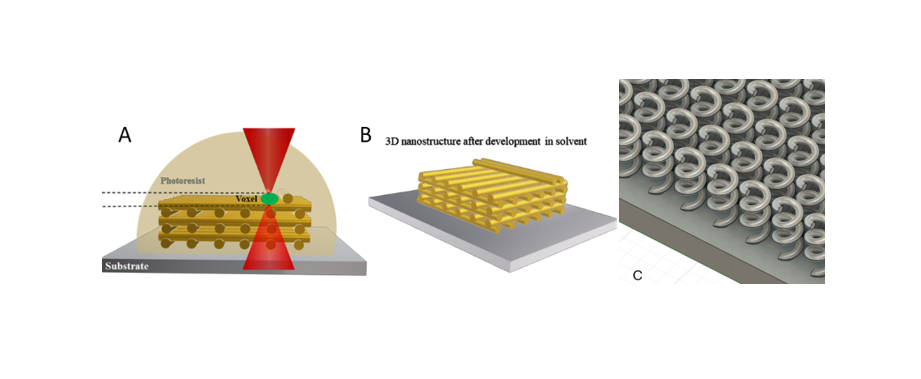
Multi-Photon Lithography (MPL) is an advanced fabrication technique that allows direct, maskless writing of true 3D micro- and nanostructures using computer-aided design (CAD) models.[1] The process is based on multi-photon absorption in a photosensitive material, which occurs only upon tight focus of a femtosecond laser beam (Fig. 1A). After this absorption, free radicals are generated in the photoresist, which initiate polymerisation by bonding with monomers and eventually forming a solid polymer network. Therefore, stable 3D structures can be produced inside the bulk of the resist rather than being restricted to its surface (Fig. 1B). [2]
MPL photoresists are typically negative-tone materials, most commonly based on acrylate or epoxy polymers. In addition, hybrid organic–inorganic materials have gained increasing attention because they exhibit reduced polymerisation shrinkage and improved mechanical stability.[2] In this work, the hybrid organic–inorganic photoresist SZ2080 was used. It contains a zirconium-based inorganic component and Michler’s ketone as a photoinitiator.
Due to its ability to fabricate complex free-form 3D geometries with high spatial resolution (down to hundreds of nanometres), MPL has been widely applied in fields such as micro-optics, photonics, mechanical metamaterials, and biomedical engineering. It is particularly promising for producing 3D photonic crystals with engineered band gaps, as well as micro- and nanostructures controlling the phase, amplitude, and polarisation state of light.[2] In this work, we aim to propose and demonstrate 3D printed nanostructures potentially capable of such light manipulation (Fig. 1C). Additionally, 3D photonic crystals, widely used in nanophotonic applications, are presented to demonstrate the capabilities of MPL in this context.