
The impact of heavy metal contamination on biological systems can not be underestimated. Originating primarily from human industrial activities such as electroplating, batteries production and mining, these metals can cause damage to cardiovascular, skeletal, nervous and other systems in organisms. Consequently, monitoring those metals in water systems is therefore valuable for environmental stability and public health. Reliable sensors based on different detection methods for detecting those metals are ideal candidates for such a task. Among them, electrochemical sensors are considered one of the best options due to their high sensitivity and accuracy, as well as their rapid response and simple sample preparation procedures. In electrochemical sensing, the choice of material is critical – not only for overall sensor performance, but also for enhancing the sensitivity and selectivity of the sensing platform. MXenes, a family of two-dimensional nanostructures, are known for their graphite-like electrical conductivity and tunable surface functional groups, making them particularly attractive for electrochemical sensor applications [1-3]. In addition to material selection, the sensing strategy itself plays a crucial role. Developing methods that can be used outside laboratory environments is especially valuable for on-site monitoring. In this work, we explore the use of an MXene-based electrochemical sensor for on-site detection of zinc, lead, and cadmium ions in water sources. The sensor was fabricated by drop-casting a MXene+Nafion combination onto a glassy carbon electrode (GCE) surface in three layers. All electrochemical measurements were conducted in acetic buffer solution at pH 4.5. Measurements in various water sources were performed by adding a small amount of highly concentrated acetic buffer to the sample and mixing thoroughly. Sensor successfully detected cadmium, lead and zinc ions with detectable peaks emerging at concentration of 100 nM (Fig. 1), 250 nM and 30µM, respectfully. The sensitivity was within World Health Organization (WHO) requirements for water systems quality monitoring. 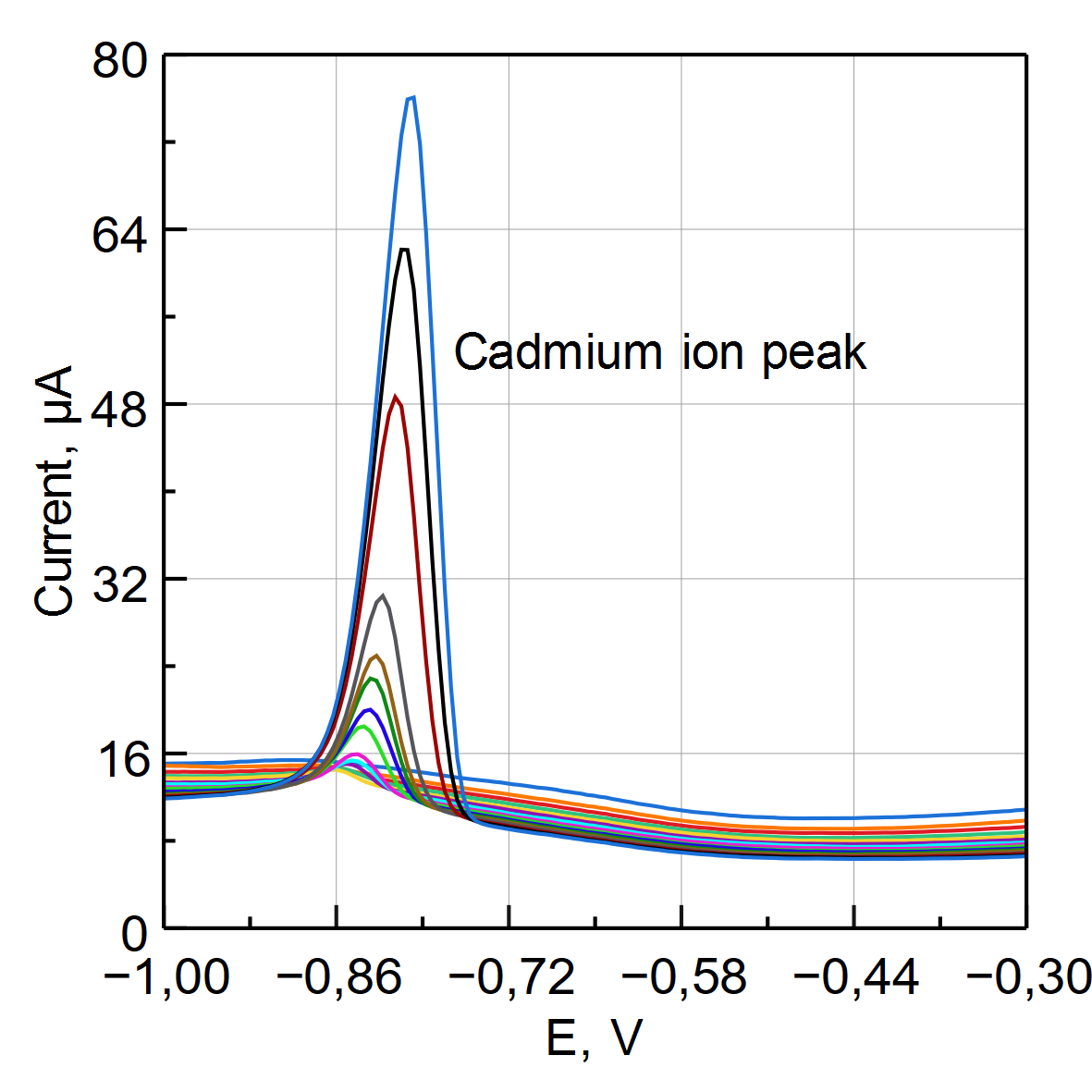
MXENES-BASED ON-SITE HEAVY METAL SENSOR
Ilya Navitski1, Šarūnas Žukauskas2, Simonas Ramanavičius1, Alma Ručinskienė1, Arūnas Ramanavičius3
1 State Research Institute Center for Physical Sciences and Technology (FTMC), Department of Electrochemical Material Sciences, Lithuania
2 State Research Institute Center for Physical Science and Technology (FTMC), Department of Nanotechnology, Lithuania
3 Vilnius University, Faculty of Chemistry and Geosciences, Lithuania
[1] I. Navitski, S. Zukauskas, S. Ramanavicius, O. Gogotsi, and A. Ramanavicius, “2D MXenes in the design of heavy metal ion sensors (review),” Trends in Environmental Analytical Chemistry, vol. 47, p. e00270, Jun. 2025, doi: 10.1016/j.teac.2025.e00270.
[2] I. Navitski, A. Ramanaviciute, S. Ramanavicius, M. Pogorielov, and A. Ramanavicius, “MXENE-Based Chemo-Sensors and other sensing devices,” Nanomaterials, vol. 14, no. 5, p. 447, Feb. 2024, doi: 10.3390/nano14050447.
[3] S. Zukauskas et al., “Electrochemical real-time sensor for the detection of Pb(II) ions based on Ti3C2Tx MXene,” The Science of the Total Environment, vol. 950, p. 175190, Jul. 2024, doi: 10.1016/j.scitotenv.2024.175190.