
$H NMR SPECTRA OF WATER IN AQUEOUS MIXTURES OF 1-BUTYL-3-METHYL-IMIDAZOLIUM TETRAFLUOROBORATE IONIC LIQUID} Nuclear magnetic resonance (NMR) spectroscopy is an indestructive method of examining the molecular structure of a chemical compound. It relies on the excitation of an atom’s nucleus to a higher energy spin state and the subsequent reemission of radio frequency radiation, which produces a signal. Since experimentally observed signals can be difficult to interpret, theoretical calculations allowing for extensive monitoring of the molecular environment of the compound being investigated are often employed. Lately, there have been numerous studies modelling \(^{1}\)H NMR spectra of ionic liquids (ILs) and their aqueous mixtures aiming to overcome the computational challenges posed by local anisotropy and a wide array of different intermolecular interaction types with no clear dominant interaction [1]. In a recent computational \(^{1}\)H NMR study [2], it was found that the chemical shift of water in an aqueous IL solution is very sensitive to the molar fraction of the IL, making water particularly useful as a probe of intermolecular configuration. As such, it is important to develop methods allowing for accurate modelling of \(^{1}\)H NMR spectra of water in aqueous IL mixtures.
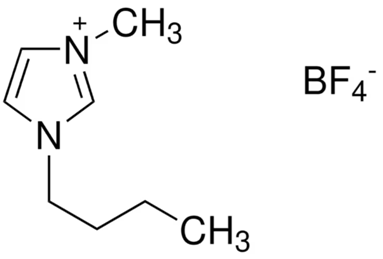
The primary goal of this study was to properly calculate the chemical shift of water in an aqueous solution of 1-butyl-3-methylimidazolium tetrafluoroborate, [C4mim][BF4] – see Fig. 1, at different molar fractions of the IL. A flexible water model was used so as to account for intramolecular processes. In order to compensate for slow intermolecular dynamics arising from the viscosity of the IL, extensive molecular dynamics (MD) simulations were performed to obtain a wide array of different configurations of the analyzed systems. Afterwards, the chemical shift of \(^{1}\)H in the various configurations was calculated using quantum mechanics/molecular mechanics (QM/MM) methods and the results were compared with experimental data.