1 Vilnius University, Faculty of Physics, Institute of Chemical Physics, Saulėtekio ave. 3, LT-10257 Vilnius, Lithuania
Zirconium phosphates (ZrP) are a family of materials used in variety of applications including batteries, supercapacitors, catalysis and medicine as drug carriers [1, 2]. They are 2D materials, which, due to their polymorphic structure, are classified as α-, γ- and λ- ZrP. These compounds are suitable for intercalation with various ions (Na\(^{+}\), K\(^{+}\), NH\(^{+}_{4}\), Cl\(^{-}\) and others), enabling tailoring for a wide range of applications [3].
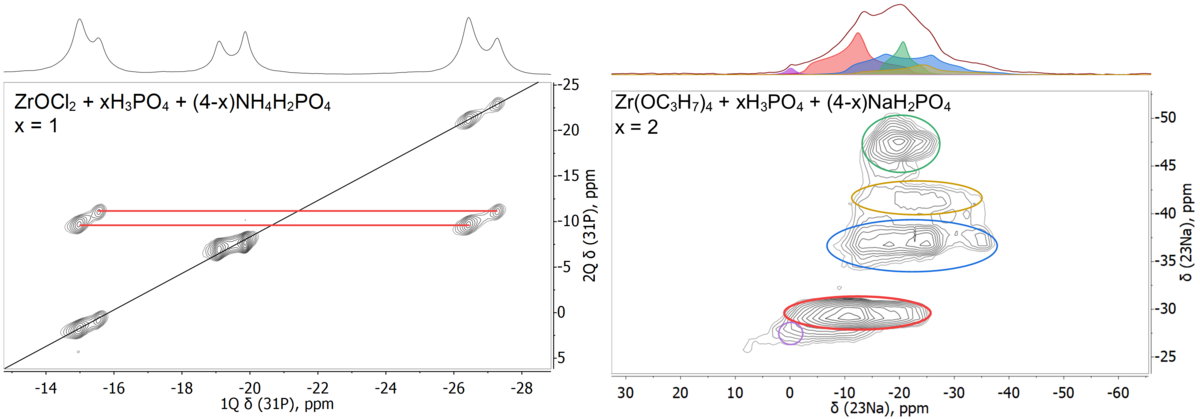
In this study solid-state Nuclear Magnetic Resonance (ssNMR) was used to characterize α- and γ- ZrP polymorphs doped with NH\(^{+}_{4}\), K\(^{+}\) and Na\(^{+}\) ions. \(^{31}\)P and \(^{23}\)Na MAS NMR methods were used to determine the composition of the samples. Alongside 2D NMR techniques, such as \(^{31}\)P-\(^{31}\)P 1Q-2Q and \(^{23}\)Na MQMAS NMR, it was possible to assign \(^{31}\)P MAS NMR spectral lines to different crystal motifs of ZrP polymorphs and determine number of distinct \(^{23}\)Na environments present in the samples.
Fig. 1. 31P-31P 1Q-2Q (left) and 23Na MQMAS (right) NMR spectra of α- and γ- ZrP polymorphs. Horizontal projections of 2D spectra correspond to 1D 31P and 23Na MAS NMR spectra.
It was found that α- and γ- polymorphs intercalated with NH\(^{+}_{4}\), K\(^{+}\) and Na\(^{+}\) were formed during synthesis procedure. Additional ion exchange with hydrochloric acid (HCl) was performed to remove intercalated ions and confirm previous results. The \(^{31}\)P-\(^{31}\)P 1Q-2Q NMR data enabled the identification of two structural phases of NH\(_{4}\)ZrP polymorphs and explanation of crystal structure of α-KZrP. Furthermore, intercalation with Na\(^{+}\) ions yielded products with four distinct \(^{23}\)Na chemical environments of NaZrP.
[1] M. Casciola, “From layered zirconium phosphates and phosphonates to nanofillers for ionomeric membranes,” Solid State Ionics, vol. 336, pp. 1–10, Mar. 2019, doi: 10.1016/j.ssi.2019.03.005.
[2] M. V. Ramos-Garcés, J. González-Villegas, A. López-Cubero, and J. L. Colón, “New applications of zirconium phosphate nanomaterials,” Accounts of Materials Research, vol. 2, no. 9, pp. 793–803, Sep. 2021, doi: 10.1021/accountsmr.1c00102.
[3] C. Bisio et al., “Recent advances and perspectives on intercalation layered compounds part 1: design and applications in the field of energy,” Dalton Transactions, vol. 53, no. 35, pp. 14525–14550, Jan. 2024, doi: 10.1039/d4dt00755g.