
In recent years, aromatic fluorine-containing compounds have been increasingly studied for their potential as pharmaceutical molecules, especially in the development of anticancer drugs. The physicochemical properties of fluorine, such as high bond strength, and minimal steric hindrance contribute to improved pharmacokinetics of medicinal molecules. Since many FDA-approved drugs are based on heterocyclic cores, the incorporation of heterocyclic motifs is essential in the synthesis of organic molecules with potential anticancer properties [1, 2].
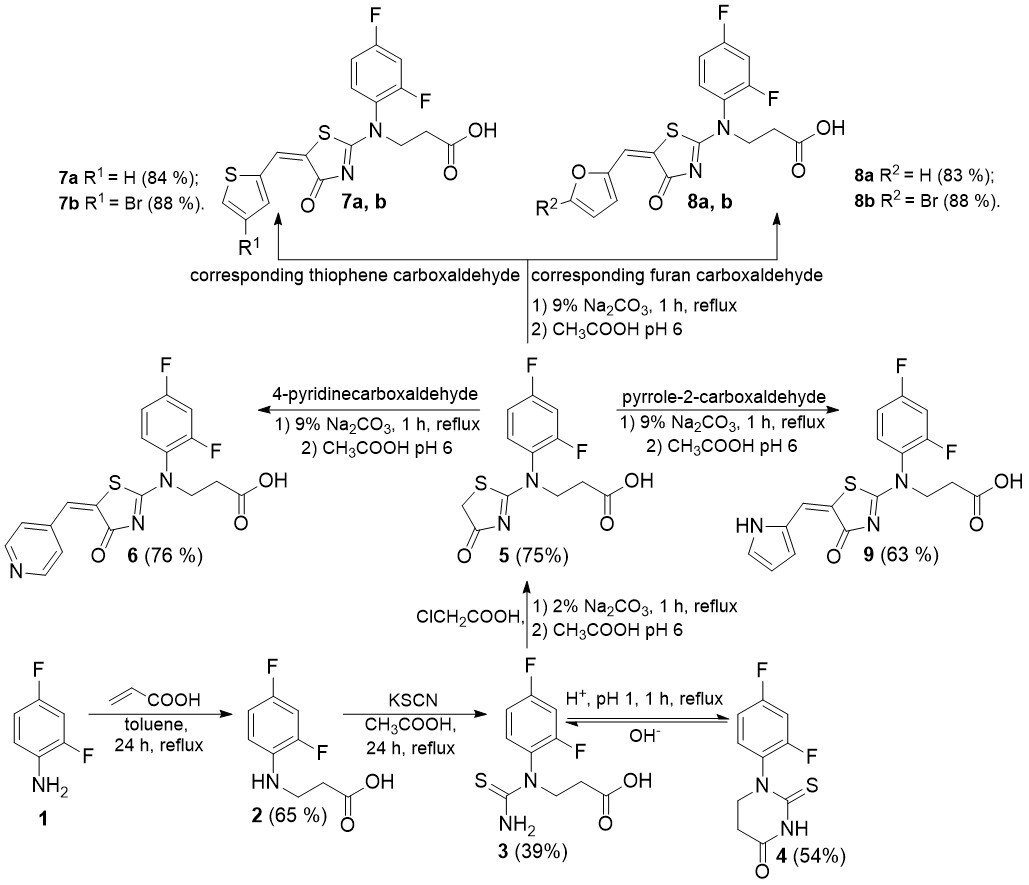
In this work, compounds (–9) containing a thiazolone moiety were synthesized. 3-[(2,4-Difluorophenyl)amino]propanoic acid () was first obtained by the reaction of 2,4-difluoroaniline () with acrylic acid. Subsequently, it was transformed into 3-[1-(2,4-difluorophenyl)thioureido]propanoic acid () by dissolving compound in acetic acid, followed by the addition of potassium thiocyanate and stirring the reaction mixture under reflux. Since cyclic compound was also formed during this reaction, complete cyclization of the product was achieved by heating it with hydrochloric acid. 3-[(2,4-Difluorophenyl)(4-oxo-4,5-dihydrothiazol-2-yl)amino]propanoic acid () was obtained by refluxing thioureido acid with chloroacetic acid. The resulting product was further used in condensation reactions with various heterocyclic aldehydes (Fig. 1).
The structure of the synthesized compounds has been proven by \(^{1}\)H NMR, \(^{13}\)C NMR and other spectroscopic methods. Investigation of the anticancer activity of the synthesized compounds are planned.