Conventional drug administration routes, such as oral and intravenous delivery, can be affected by poor bioavailability, limited patient compliance, and inadequate targeting ability. Moreover, many drug classes, including peptides, genes, and small molecules, are hindered by poor solubility and lipophilicity, enzymatic degradation, insufficient absorption within the body, and premature activation [1,2]. These challenges can be addressed by drug delivery systems (DDS) through improvements in drug stability and targeting ability, which expand the range of viable therapeutic targets, enhance safety, and reduce side effects [3].
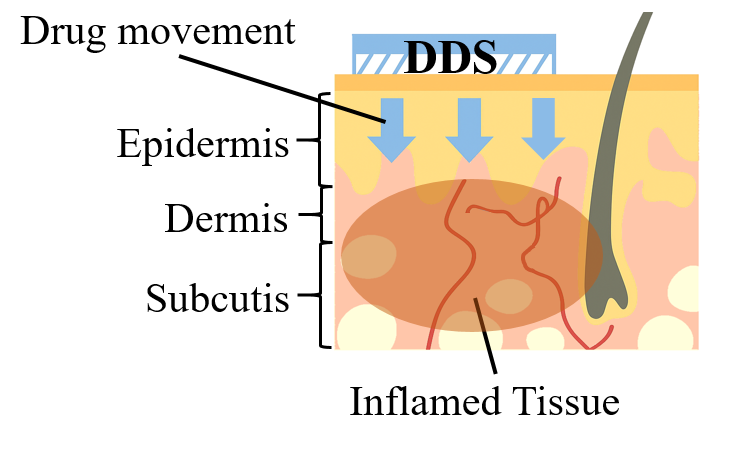
For the development of a polymer-based DDS, initial efforts were directed toward establishing a reliable method for producing and depositing the desired polymer. Subsequently, a protocol for drug incorporation was established, and preliminary drug release tests under different conditions were performed as a proof of concept for a topical DDS. A general depiction of a topical DDS is shown in Figure 1. The finished DDS is intended for topical use; therefore, polypyrrole (PPY) was selected as the polymer matrix due to its biocompatibility, electroactivity, and availability.
To ensure repeatable and uniform polymer deposition, an extensive electrode preparation and polymer deposition protocol was designed. This protocol was focused on maximizing the amount of deposited polymer while minimizing overoxidation. Ibuprofen (Ibu) was selected as the model drug to be delivered. Integration of Ibu into the polymer matrix was achieved by its presence in the reaction solution during electrochemical polymerization. Drug release was monitored and analyzed using UV–Vis spectroscopy.