At resonant conditions, different nonlinear spectroscopic signals can be unambiguously associated with specific Feynman diagrams describing distinct sequences of light–matter interactions. In contrast, under off-resonant conditions all interaction pathways can acquire comparable amplitudes and must be coherently summed in the signal calculation. This situation arises, for example, in second-harmonic generation from transparent media, where the microscopic origin of the signal—electronic versus vibrational—remains ambiguous, as in protein SHG experiments.
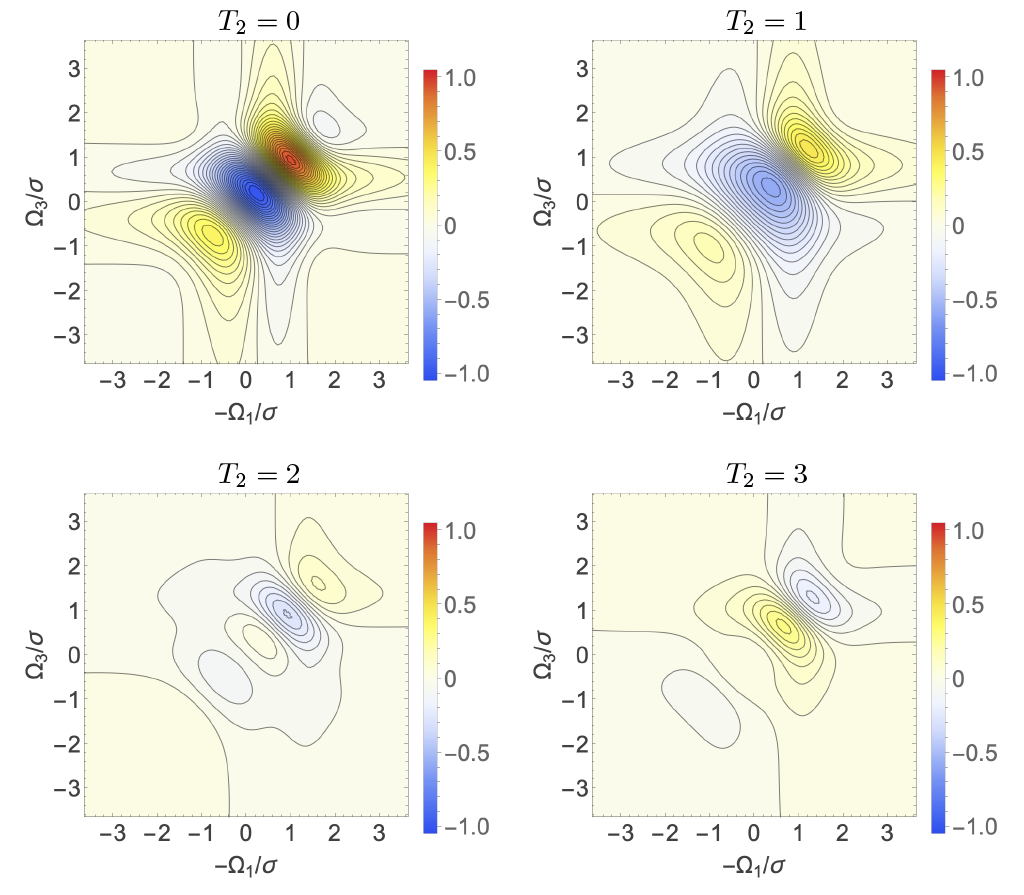
Partially off-resonant conditions are also encountered in third-order nonlinear measurements such as two-dimensional electronic spectroscopy (2DES). In the interpretation of 2DES, the waiting time \(T_2\) is commonly associated with excited-state population dynamics, while the ground-state bleaching contribution is often considered dynamically trivial during this interval. This assumption is justified under resonant conditions, where electronic population and coherence dominate the signal. However, under partially off-resonant or transparent-window conditions, the system remains electronically in the ground state during \(T_2\), and the role of nuclear degrees of freedom becomes less clear. In this case, virtual electronic polarization can mediate Raman-type vibrational coherences that evolve during \(T_2\) and contribute to the measured errors of the third-order signal spectra. Understanding the role of these ground-state vibrational contributions is therefore essential for the correct interpretation of 2DES spectra obtained under off-resonant conditions. In this presentation, an off-resonant theoretical approach for calculating 2DES signals in transparent media is discussed. It is shown that solvent vibrational modes may lead to systematic, non-random contributions to the measured spectra, resulting in structured 2DES features rather than purely stochastic noise. These effects are illustrated by calculated 2DES spectra of a transparent medium in an off-resonant transparency window (Fig. 1).