
Light Detection and Ranging (LiDAR) is a cornerstone technology for autonomous navigation and 3D environment mapping. Most beam-scanning LiDAR systems rely on moving mirrors and thus are limited by mechanical inertia.
An attractive alternative is employing akinetic scanning, where MHz line scans become possible without using moving parts. One candidate for such approach to LIDAR is spectro-temporal scanning [1], where a wavelength-swept laser source, such as an FDML laser [2] is used with a diffractive element to achieve a fast, akinetic line scan (see Fig. 1).
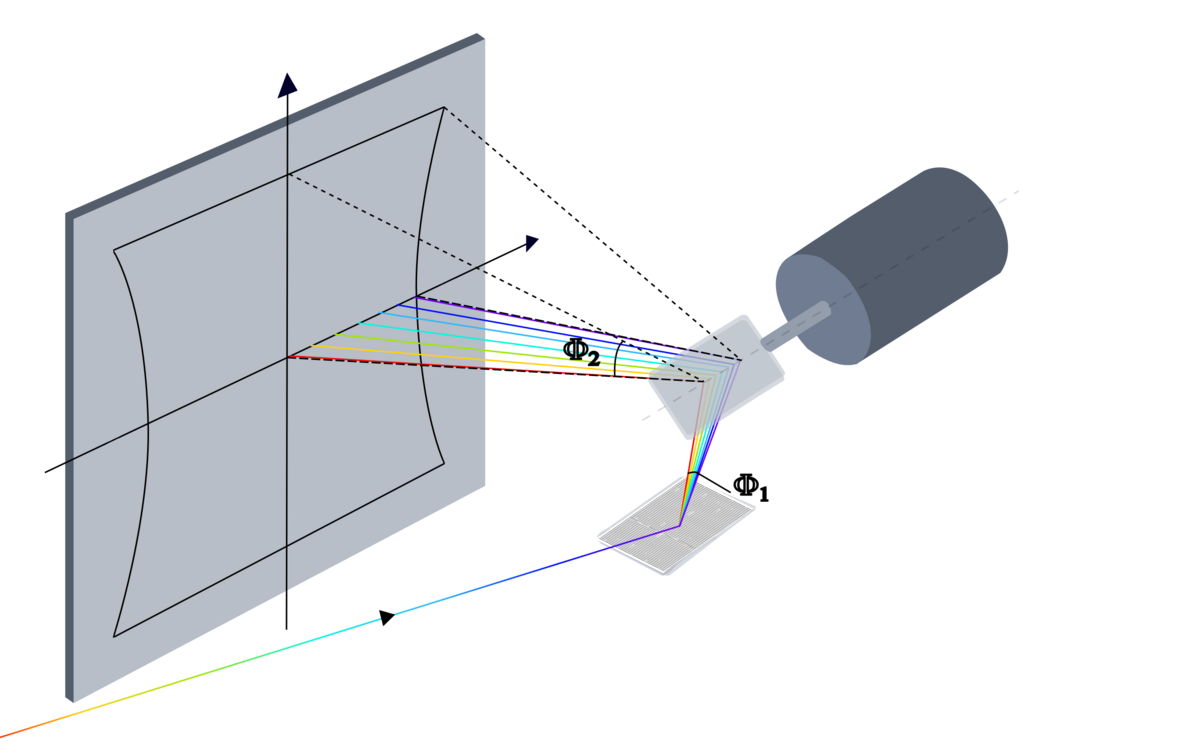
While spectro-temporal scanning allows high framerate scanning, acquisition still relies on digitization of the signal of a fast photodetector. Thus, to enable 3D information recording by such akinetic LiDAR system from dynamic scenes or fast-moving objects, 3D data must be accurately and rapidly reconstructed from the 1D data stream.
In order to develop and validate high-throughput 3D data processing, we employed an approach based on photodetector signal emulation. An experimental setup was constructed using an arbitrary waveform generator that simulates detector signal waveform, corresponding to 3D data from a beam-scanned scene. The study utilized a high-performance C++ software framework to enable low-latency data transfer and real-time processing.
The custom algorithm was used for real-time image reconstruction, incorporating phase-shift synchronization and interpolation to map time-domain signals to spatial coordinates. The system achieved a data processing throughput of over 200 MS/s, exceeding the hardware limit of the digitizer (180 MS/s). The reconstruction accuracy was quantified using a root-mean-square error (RMSE) metric, confirming high signal fidelity (<2%).
This work demonstrates a software-hardware interface capable of handling the data rates required for future low-latency LiDAR applications.