Active Galactic Nuclei (AGNs) are supermassive black holes at the centers of galaxies that actively consume matter and release enormous amounts of energy. AGNs flicker in bursts that each last approximately 0.1 million years [1], with quiescent periods in between. Despite low duty cycle behavior, the cumulative energy released across multiple AGN episodes is enough to disrupt the galaxies. However, most of the energy escapes as radiation, and the remaining energy fraction that does interact with the gas forms AGN wind-driven outflows [2] that redistribute gas in the galaxies.
Previous research has shown that fast outflows (moving faster than 500 km/s) can sweep gas out of the galactic bulge. They remove this raw material for star formation and simultaneously disrupt molecular clouds quenching the ongoing star formation in the galaxy. However, the effects of slower outflows remain poorly understood. It is unclear whether star formation is always suppressed or whether it might sometimes be triggered. Recent studies have provided evidence that outflows can trigger star formation - outflows and young stars are found co-spatially with comparable radial velocities, suggesting enhanced star formation in action [3]. The conditions required for such enhanced star formation to occur and kinematic properties of such newborn stars are the central questions my research addresses.
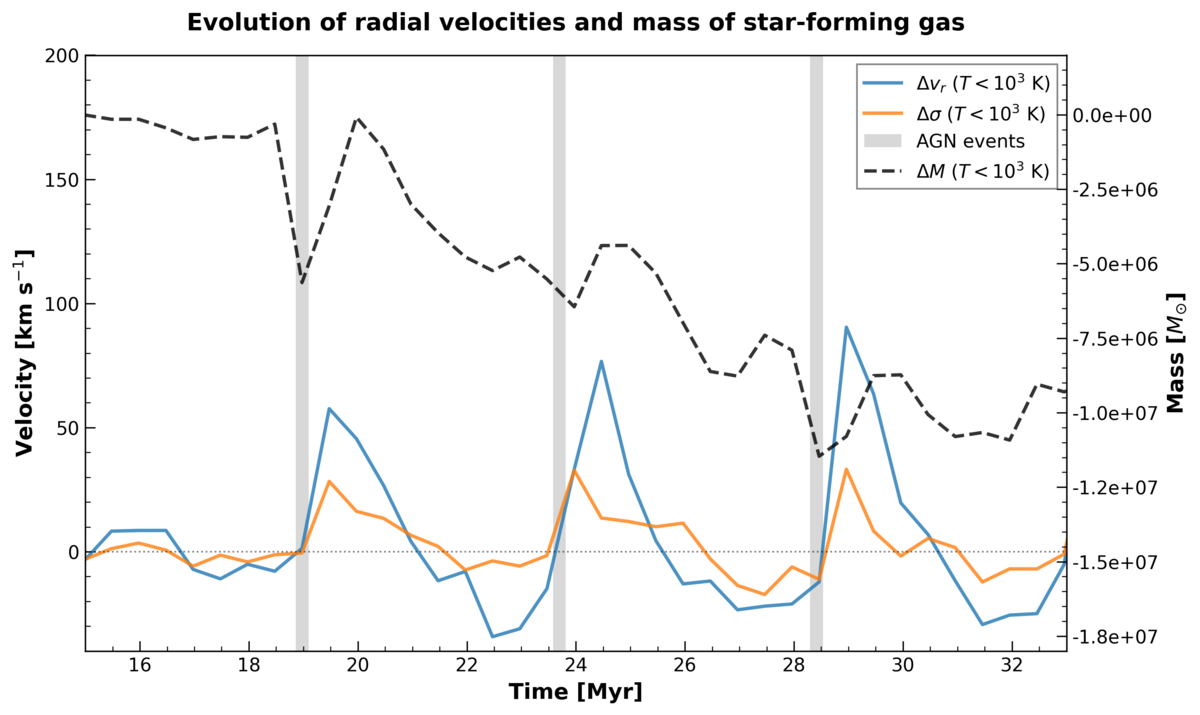
To investigate these questions, AGN-driven outflows and their interaction with the galactic environment are simulated. The Smoothed Particle Hydrodynamics method is used to model several AGN episodes and to track how the multiphase outflow propagates through the central kiloparsec of the galaxy. A dual nature of AGN feedback is confirmed by the simulations. As the outflow expands through the bulge, the surrounding material is swept up and compressed, and fast-moving stars are formed within the moving gas streams. Therefore, star formation can be stimulated rather than suppressed by AGN-driven outflows. On the other hand, molecular clouds are disrupted and gas is expelled from the galactic centre by powerful outflows, and the fuel needed for future star formation is removed.
The relative importance of these competing feedback mechanisms will be quantified. It will be shown how the spatial distribution of newly formed stars and the radial velocity dispersion of the stellar population are affected (see Fig.1). Understanding this balance is crucial for explaining how galaxies co-evolve with their central supermassive black holes and what effect is produced on the scatter of the observed \(M-\sigma\) relation [4].