Amyloidosis is a general term describing diseases that develop when there is an accumulation of proteins that have lost their biological function due to altered secondary structures [1]. Such proteins arise from misfolding or when broken down into separate, irregular fragments which connect and form insoluble, stable beta-fibrillar structure. The resulting aggregates of these structures are called amyloids. These deposits are resistant to proteolytic enzymes, such as proteases, which maintain protein homeostasis by degrading proteins. When this process is disrupted, systemic and localized forms of amyloidosis begin to develop, causing neurodegenerative diseases, such as Parkinson’s and Alzheimer’s diseases, localized in the brain [2]. During various scientific studies, it was observed that compounds containing small-molecular weight heterocyclic fragments are able to inhibit the formation of amyloid aggregates in the body [3, 4].
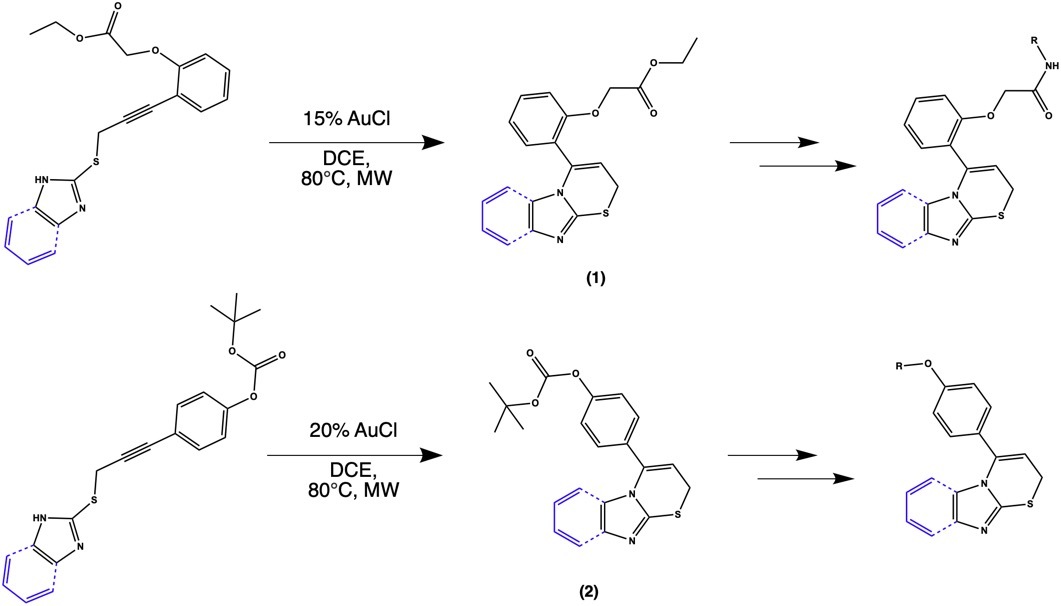
The aim of this work is to increase the variety of compounds that would exhibit the properties of modulators of amyloid aggregates. Therefore, the primary objective of this work is to synthesize compounds containing (imidazo[2,1-b][1,3]thiazin-4-yl)phenols with a heterocyclic fragment at different positions and modify them. 2-iodo and 4-iodophenols were chosen as starting compounds. Due to reactivity, the hydroxy groups were modified in the first step. This was followed by the addition of the triple bond and the subsequent replacement of the introduced propargyl bromide group with thioimidazole fragments. Following a gold-catalyzed cyclization reaction, the target (imidazo[2,1- b][1,3]thiazin-4-yl)phenols 1 and 2 were isolated. Their corresponding hydroxyl groups were further modified to target amides, esters and ethers for further evaluation in amyloid protein aggregation studies.