Decommissioning nuclear power plants creates large quantities of radioactive metallic waste, 99% of which is classified as being of low or medium contamination [1], therefore suitable for deactivation and reusing. This study investigated the use of laser surface ablation as an alternative to existing techniques which generate significant secondary waste. For this study, a 200 W pulsed fiber laser (50 ns pulse duration, 150 kHz repetition rate, 0.1 mm spot size, 20 000 mm/s scanning speed), mounted on a mechanical platform, which could move 10 cm from the central position was used. A modified circuit breaker box was used for the cleaning chamber. Particles generated from laser ablation were removed from the chamber by a vacuum cleaner and filtered through a HEPA filter.
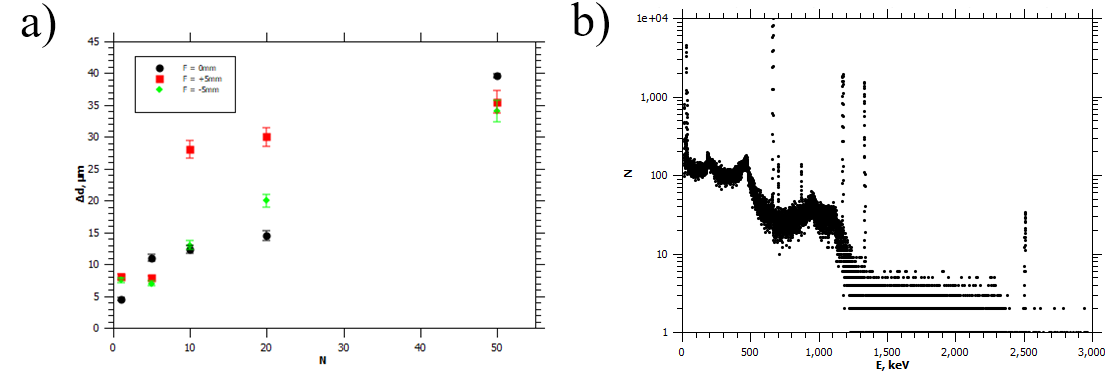
To analyze the ablation process, surface profiles were measured using an optical profilometer. A sample was prepared, consisting of 15 cleaned squares, 10 mm × 10 mm, on a rust-covered sheet of steel. The cleaned squares were produced at 3 distances away from the laser – at the focal point (210 mm from the laser), 215 mm and 205 mm. For each distance 5 different numbers of scans were performed: 1, 5, 10, 20 and 50. After performing the analyses, the results show that the greatest surface ablation with 50 scans was achieved with 210 mm distance cleaning (Figure 1a). The dependence of the ablation depth on the number of scans is logarithmic. The cleaning efficiency (depth per scan) decreases exponentially as the number of scans increases. In order to test deactivation efficiency, 6 non-core metal samples from Ignalina NPP were cleaned. A CeBr\(_3\) gamma spectrometer mounted next to the laser was used to register the spectra of the samples during the cleaning process. The detector was calibrated using known sources of Cs-137 and Eu-152. Subsequently, the residue samples taken from the chamber walls were analyzed with an HPGe spectrometer (Figure 1b). The presence of Cs-137, Co-60 and Nb-94 confirmed removal from the surface, as these radionuclides do not appear naturally in such quantities [2].
Measured results showed an average dose rate reduction of 44%, Cs-137 surface activity reduction of 38%, and Co-60 reduction of 25%, with the best sample reaching 75% dose reduction. This confirms that surface ablation of contaminated metals removes not only rust but effectively cleans off radioactive particles. This leads us to believe that laser surface ablation is a practical and controlled method for radioactive metal surface deactivation [3], allows micrometer-scale surface layer removal and measurable reduction of radioactivity, making it a promising alternative for nuclear decommissioning waste treatment