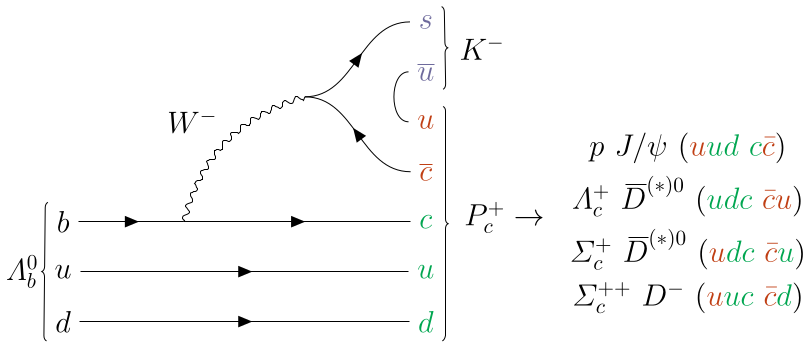
Charmed pentaquark states (\(P_c^+\)) have first been observed by LHCb collaboration in 2015 in \(\Lambda_b^0 \to J/\psi p K^-\) decay channel [1]. \(P_c^+\) states have not yet been observed in other channels. \(\Sigma_c^+ \bar{D}^{(*)0}\) systems are interesting for pentaquark search because they have the same quark content as \(J/\psi p\) system (\(uudc\bar{c}\)) and their inertial masses are very close to the observed \(P_c^+\) masses. \(\Lambda_b^0 \to \Sigma_c^+ \bar{D}^{(*)0} K^-\) decay channels have not yet been analysed for pentaquark signals. Observation of \(P_c^+\) signals in these channels or determination of signal upper limits would help constrain theoretical models that are currently unable to unambiguously describe the observed \(P_c^+\) states.
The aim of this doctoral research is to analyse \(\Lambda_b^0 \to \Sigma_c^+ \bar{D}^{0} K^-\) decay channel for \(P_c^+\)signals using LHCb Run3 data. This research topic branches off from Mindaugas Šarpis thesis where \(\Lambda_b^0 \to \Lambda_c^+ \bar{D}^{*0} K^-\) decay channel was analysed using LHCb Run2 data [2]. A quark diagram that summarizes different possible \(\Lambda_b^0 \to P_c^+ K^-\) decay channels is shown in Fig. 1.
One of the challenges of this research will be to isolate \(\Lambda_b^0 \to \Sigma_c^+ \bar{D}^{0} K^-\) decay channel in LHCb Run3 data. This channel has a major overlap with \(\Lambda_b^0 \to \Lambda_c^+ \bar{D}^{*0} K^-\) channel in \(\Lambda_b^0\) invariant mass spectrum. One approach to address this issue will be to utilize Monte Carlo (MC) event generator results for the overlapping decay channels and train a classifier model on experimental data in the narrow regions where the MC generated overlap is minimal. Analysis of \(\Lambda_b^0 \to \Sigma_c^+ \bar{D}^{*0} K^-\) decay channel is also considered. These decays produce additional neutral particles (\(\pi_0\) or \(\gamma\)) that are not efficiently detected. This results in \(\Lambda_b^0 \to \Sigma_c^+ \bar{D}^{*0} K^-\) signal being shifted towards lower energies than \(\Lambda_b^0 \to \Sigma_c^+ \bar{D}^{(*)0} K^-\) signal in the mass spectrum, avoiding signal overlap. The neutral particles can be reconstructed later by utilizing Extended Cone Closure method, introduced by Šarpis [2].