
Growing energy demand and environmental challenges drive the development of technologies aimed at reducing energy consumption in buildings [1]. Electrochromic smart windows are a promising solution, as their optical properties can be actively controlled by an electrical signal, enabling dynamic regulation of light transmission and reflectance.
In this work, the interaction between microcopper transparent electrodes and electrochromic materials is investigated for smart window applications. Microstructured copper electrodes were fabricated on glass substrates using Selective Surface Activation Induced by Laser (SSAIL) technology as an alternative to conventional transparent conductive oxide electrodes, such as ITO [2]. Tungsten oxide (WO₃) and PEDOT:PSS were studied as inorganic and organic electrochromic materials using lithium-based (LiClO₄) and proton-based (H₂SO₄) electrolytes, with optical transmittance measurements used to evaluate switching behavior and stability.
PEDOT:PSS-based devices exhibited fast and reversible electrochromic switching in proton-conducting electrolytes, with stable optical modulation at low operating voltages and high transparency in the bleached state. In contrast, WO₃-based devices operated with lithium-based electrolytes showed unstable behavior, resulting in partial degradation of the smart window and reduced electrochromic performance. These results highlight the strong influence of electrolyte selection on electrochromic stability and device reliability. 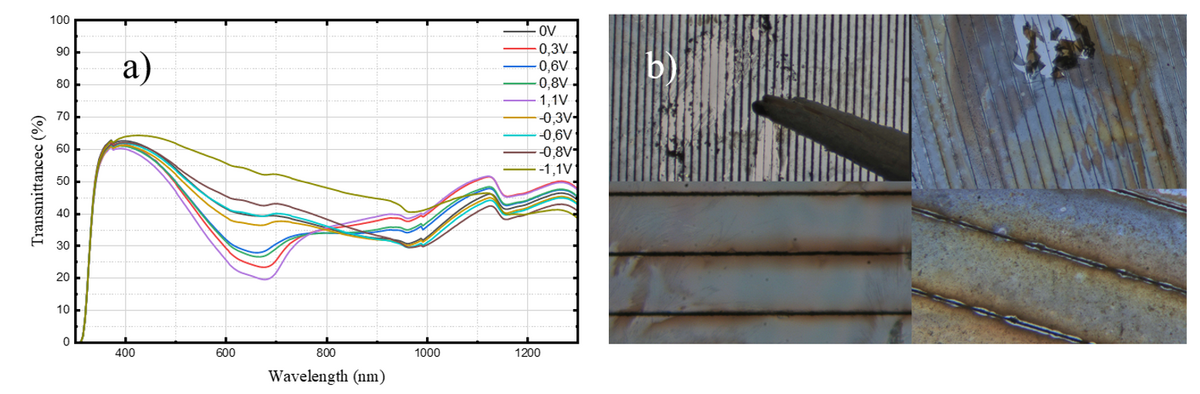
Future research will focus on improving device stability and durability by optimizing electrolyte systems and electrode-electrolyte interfaces. The implementation of gel or solid-state electrolytes, like PVA [3], together with improved electrode designs, is expected to further advance the performance of electrochromic smart windows.