Most newborn stars form in star clusters (SCs), making them fundamental building blocks of their host galaxies. The properties of SC populations, such as the mass–radius relation (MRR), encode information on cluster structure at birth and effects of subsequent dynamical evolution. Observational constraints on the MRR, its evolution, and environmental dependence, provide crucial tests of star and cluster formation models, as well as theories of SC dynamical evolution. The Andromeda galaxy (M31) is ideal for such studies due to its proximity, large cluster sample, and similarity to the Milky Way.
This study is based on observations obtained with the Hubble Space Telescope as part of the Panchromatic Hubble Andromeda Treasury (PHAT) survey [1]. We use the M31 SC catalogue [2], which provides cluster physical (age, mass, and extinction) and structural parameters derived for 1922 SCs from integrated aperture photometry.
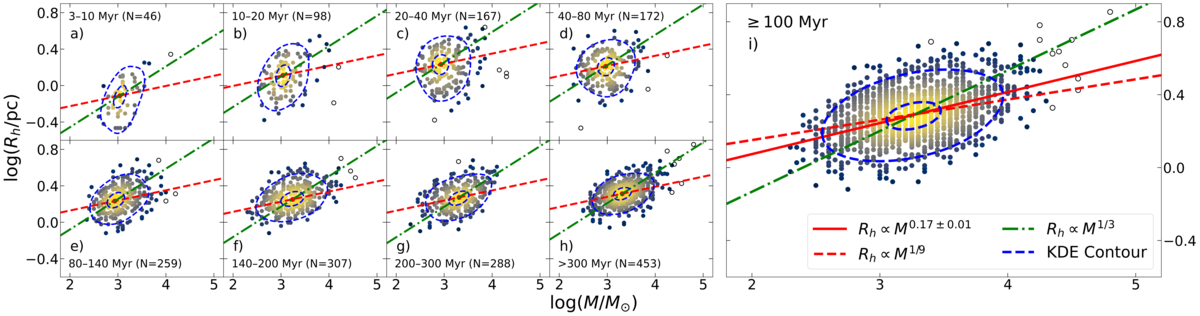
Within the first \(\sim\)50 Myr, SCs undergo rapid expansion (Fig. 1a-d), with the mean half-light radius, \(R_{h}\), increasing by a factor of two (from \(\sim\)0.7 pc to \(\sim\)1.4 pc). We attribute this early expansion to stellar evolution effects, including massive star feedback, supernovae, and mass loss due to the expulsion of primordial gas.
For clusters older than \(\sim\)100 Myr (Fig. 1e-i), a shallow MRR emerges, with \(R_{h}\) \(\propto\) \(M^{0.17\pm0.01}\). This slope is shallower than those reported for more distant galaxies (\(R_{h}\) \(\propto\) \(M^{0.25-0.33}\); [3]). A comparison with the other Local Group galaxies reveals power-law indices ranging from 0.06 to 0.50. These results suggest a possible environmental dependence of the MRR. Furthermore, the observed relation for M31 SCs is significantly shallower than the initial MRR predicted from the cluster formation models (\(R_{h}\) \(\propto\) \(M^{1/2}\) or \(M^{1/3}\); [4]), but steeper than the equilibrium relation resulting from the combined effects of tidal shocks and two-body relaxation on cluster evolution (\(R_{h}\) \(\propto\) \(M^{1/9}\); [5]). These discrepancies indicate that current theoretical models may be missing important physical processes relevant to cluster evolution in disc environments.