
Self-assembled monolayers (SAMs) have emerged as the standard hole-selective layer in high-efficiency p-i-n perovskite solar cells (PSC). [1] However, a limited understanding of structure-property relationships remains a challenge for further performance optimization. Previous studies have shown that variations in functional groups, alkyl chain length, and molecular cores can influence device performance. [2] Despite these advances, clear structure-performance correlations have not yet been established. This study provides a comparison of a broader set of nine phosphonic-acid-based molecules, evaluating their performance within the same model PSC system. [3] The objective of this work is to clarify how different substitution patterns on the carbazole core affect layer properties and photovoltaic performance.
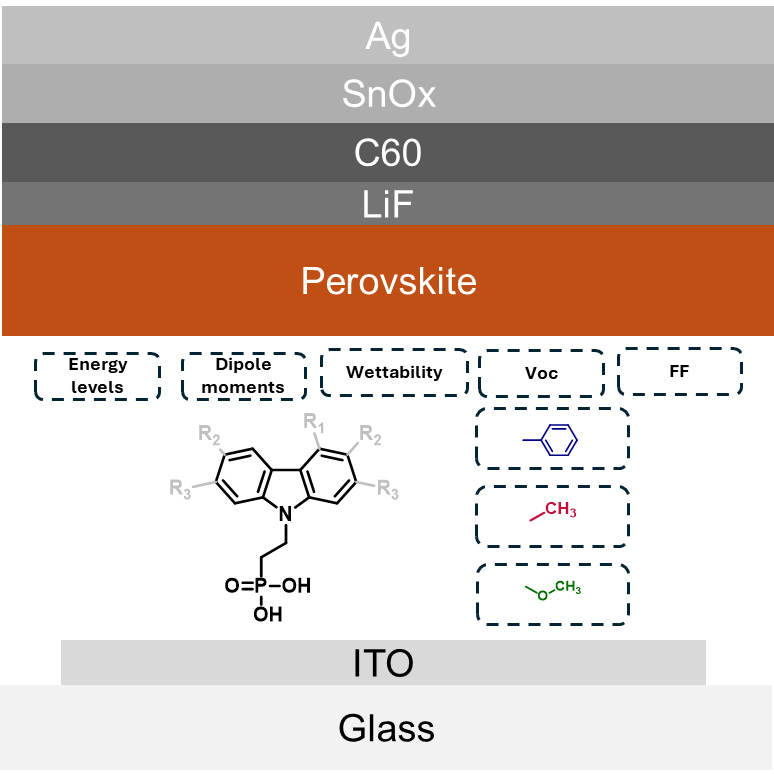
A series of differently substituted carbazole derivatives with phenyl-, methyl- and methoxy- functional groups was synthesized and integrated into devices. The influence of various functional groups was additionally examined using combined optical, thermal, and electrical characterization. Notably, SAMs substituted at the 3,6-positions delivered enhanced fill factors and power conversion efficiencies compared to other configurations. In addition, a correlation between the ionization potential and fill factor indicates the presence of a threshold value beyond which the fill factor decreases, likely due to energy level misalignment. Overall, this study provides valuable insights for future studies and the advancement of phosphonic acid-based materials for high-performance PSC.