Through glass vias (TGVs) have gathered attention for applications in Micro-Opto-Electro-Mechanical Systems (MOEMS) as interposers [1], nozzles for laser wakefield accelerators [2] and connections for microfluidic devices [3]. This is because glass works as a better electrical insulator compared to widely used silicon wafers, has high mechanical strength, and its composition can be modified to change thermal expansion coefficient. Common TGV fabrication methods like electrochemical discharge (EDM) and laser-induced chemical etching (LISE) have difficulties producing over millimeter depth holes and result in tapered openings [4].
Laser drilled TGVs can have parallel walls and multimilimeter depths when utilizing bottom-up drilling technique. This technique offers enhanced milling rate compared to top-down drilling. Additionally, milling rate can be further improved by using laser bursts which consist of multiple ultrashort pulses with intra-burst repetition rates on the order of few tens of MHz up to THz [5]. Bursts work by first heating, introducing defects, or temporarily modifying the material which lowers the ablation threshold for subsequent pulses resulting in efficient ablation. For dielectric materials, ablation mechanism changes with higher number of pulses in the GHz burst to surface cracking and subsequent expulsion of micron sized particles. Debris is often the limiting factor for the creation of high depth channels [6]. Therefore, additional debris removal methods need to be employed.
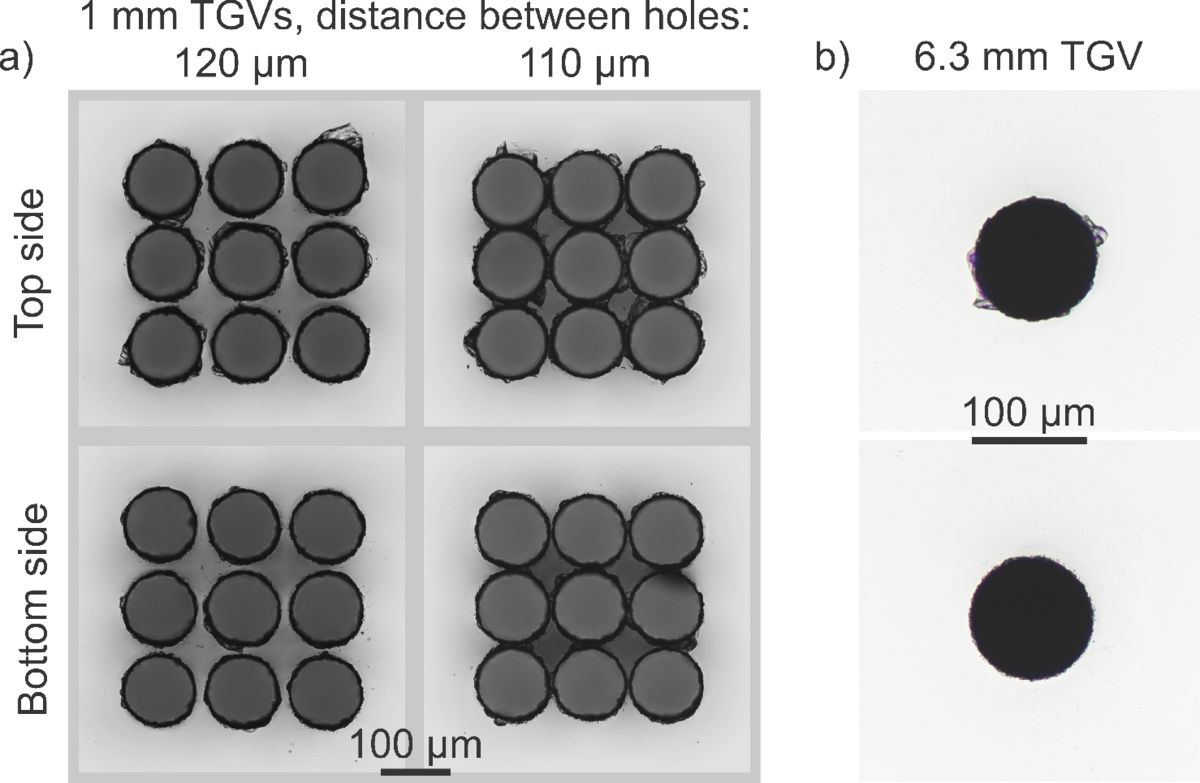
In this study, laser milling parameters – GHz burst count, burst energy, pitch, spacing, and sample translation distance during milling, were optimised. 100 µm diameter through glass vias were milled in 1 mm and 6.3 mm thickness fused silica (FS) samples as seen in Fig 1. Ultrashort pulse laser FemtoLux 30 from Ekspla was used for the experiment operating in GHz burst regime. For part of the experiments, nozzles were used to blow pressurised air at the drilling areas to enhance debris removal.
Increase in GHz burst count in bottom-up drilling of fused silica resulted in more clean and efficient milling, however, at the cost of quality due to increased surface chipping. Reduced channel to channel distance was achieved by segmenting cavity milling, where only a part of the depth was milled for a cavity before moving on to another cavity. High airflow de Laval nozzle allowed us to mill through 6.3 mm fused silica sample.