
Hematoporphyrin (HP) and its derivatives are tetrapyrrolic compounds that were among the first to be used as photosensitizers in photobiological research, diagnostics, and therapy [1].Upon absorbing photons of an appropriate wavelength, these photosensitizers transition to an excited state and can participate in both Type I and Type II photoreactions, as well as form chlorine-type photoproducts [2]. The properties of photosensitizers are influenced by environmental and structural changes, such as shifts in their aggregate state, which determine modifications of the photosensitizer’s physicochemical properties in an aqueous medium [2]. However, there is still a lack of research evaluating the influence of electron donors present in the action environment, such as the contribution of L-ascorbate to HP photochemical processes, when the photosensitizer is studied in solutions of different pH.
In this work, we investigated the changes in optical density (OD) and fluorescence (FL) of hematoporphyrin monomethyl ether (HMME) (5*10\(^{-5}\) M) in 50 mM KH\(_{2}\)PO\(_{4}\)-NaOH phosphate-buffered saline (PBS) at closely related pH levels (6.94 and 6.62), as well as its photostability. Additionally, spectral changes were compared upon the introduction of different concentrations (10\(^{-4}\) M and 10\(^{-3}\) M) of L-ascorbic acid into the system, evaluating both stability and photostability variations. Spectroscopic measurements of 1 ml samples were performed in 4x10 mm plastic semi-micro cuvettes. Between measurements, samples were stored in 1.5 ml microcentrifuge tubes in a refrigerator at +4 °C in the dark. During photostability experiments, a sample area of approximately 1 cm\(^{2}\) in the cuvettes was irradiated with a green laser (532 nm, 28 mW). The total dose (100.8 J/cm\(^{2}\)) was measured at intervals of 8.4 J/cm\(^{2}\) (from 0 J/cm\(^{2}\) to 67.2 J/cm\(^{2}\)) and 16.8 J/cm\(^{2}\) (up to 100.8 J/cm\(^{2}\)). Before each irradiation, the samples were homogenized by stirring, after which spectroscopic measurements were performed.
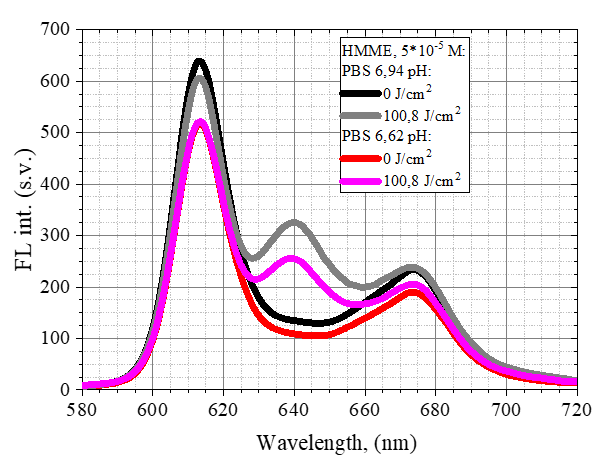
The FL spectra recorded at different excitation wavelengths revealed that, regardless of the medium pH (6.94 and 6.62), the sample exhibits multiple fluorescent species. Formation of the peak at 640 nm characteristic of photoproducts depended on the solution pH. Subsequent measurements showed that L-ascorbate actively interferes with the photooxidation reaction pathways.