
Modern tools of falsification of written documents are rapidly improving, it becames easy to forge documents and are difficult to detect.There are chemical methods that allow to detect the loss of authenticity of a document, but usually they are invasive, what is not acceptable in case of old manuscripts. Raman spectroscopy is widely used for studies of chemical constitution of fluids, but it is difficult to apply it for ballpoint pen inks of conventional written documents since the ink layers are extremally thin. Additionally, weak Raman signal is followed by strong fluorescence background arising from the ink and the paper [1]. However, surface enhanced Raman spectroscopy (SERS) usually overcomes such sensitivity and background problems, also can be used to identify document forgery, just some technical problems of the spectroscopic experiment has to be solved [2].
In our study, it was intentionally falsificated one letter in text written by ’M&G Lavender’ ball pen using identical-looking ink of ’M&G Poly Doba’ pen. Different pen inks cannot be proved neither visually nor measuring conventional Raman spectra obtained without silver colloid solution. There are no Raman spectral bands due to strong fluorescence background. The SERS spectrum was measured, after adding silver colloidal solution onto the areas marked in purple and red in Fig. 1(a). The red arrow indicates the base of the word and the purple - shows the location of the falsification. A 633 nm laser, a 40x objective were used to measure the pen ink spectrum. The laser intensity was reduced to 5 mW in order to avoid sample heating and decomposition.The SERS method allowed to identify different pen inks, even though, the colours appear identical. It can be explained by their slightly different chemical constitution. 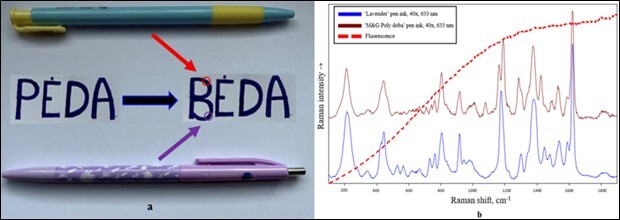
Analysis of the SERS results indicates that spectral differencies of chemically different ball pens are large enough for detection of forging documents.