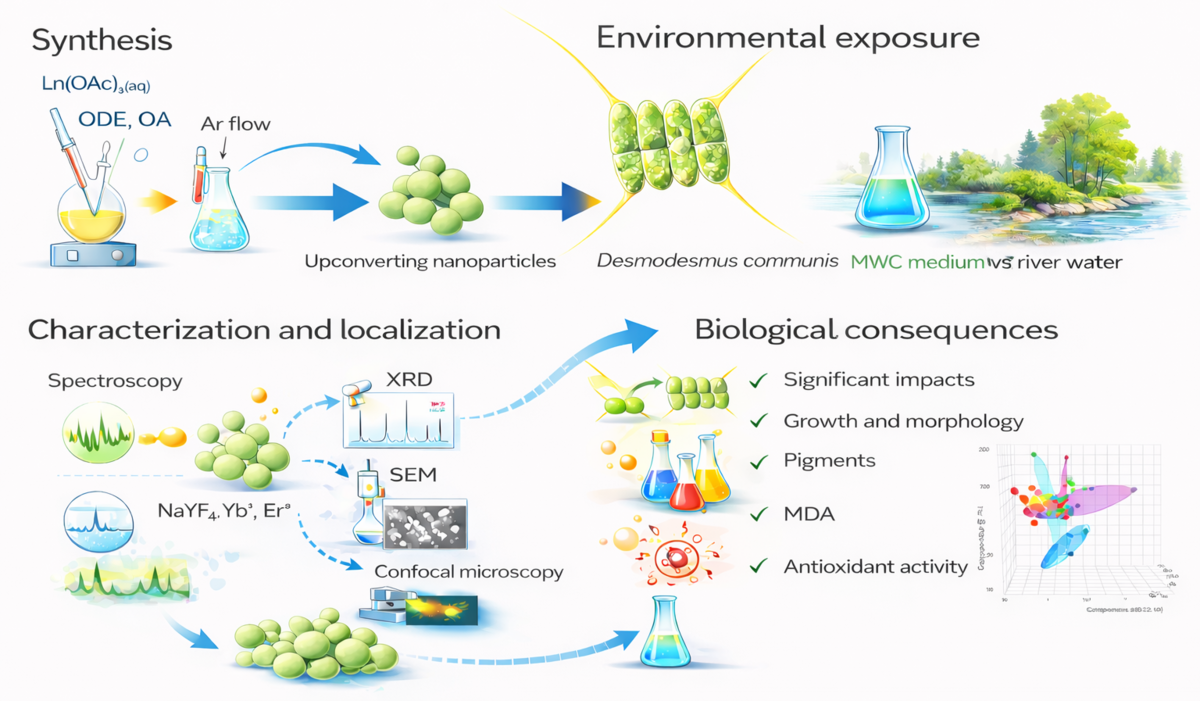
Lanthanide-doped upconverting nanoparticles (UCNPs) are increasingly explored for biomedical and sensing applications, yet their behavior and biological effects in natural freshwater environments remain poorly understood. In this study, monodisperse NaYF\(_{4}\):18%Yb\(^{3+}\), 2%Er\(^{3+}\) UCNPs were synthesized via thermal co-precipitation and rendered hydrophilic through oleate removal. The stability and biological impact of the UCNPs were investigated using the freshwater green algae Desmodesmus communis in two exposure media: nutrient-rich MWC medium and natural river water from the Neris river. Optical characterization, including absorbance, fluorescence, and upconversion emission measurements, revealed progressive nanoparticle destabilization over a 0-96 hour exposure period in both media. Algal responses were more strongly influenced by the chemical composition of the exposure medium than by UCNP concentration. Pigment content showed limited sensitivity to nanoparticle exposure, whereas oxidative stress and antioxidant responses exhibited pronounced, medium-dependent variations. Confocal microscopy indicated that UCNPs predominantly associated with the algal cell surface, with only limited evidence of cellular internalization. Multivariate partial least squares discriminant analysis (PLS-DA) further distinguished response patterns, with oxidative and antioxidant variables dominating in artificial growth medium, while growth-related parameters were more influential in river water. These findings highlight the critical role of environmental chemistry in governing UCNP stability, aggregation, bioavailability, and biological effects, underscoring the importance of realistic exposure conditions in freshwater nanomaterial risk assessment.