
As a chemical element, La appears in many electronic applications, including superconductors, most notably LaH₁₀, which holds the record for a superconducting transition temperature of 230 K [1]. The fabrication of surface-engineered devices containing La sometimes requires handling the element in a solid form protected from atmospheric exposure. Elemental La is highly chemically reactive; however, when dissolved in alloys, it becomes protected against oxidation. In this work, La was incorporated into a so-called metal-flux alloy of Pb–Bi (45:55) at a much lower temperature (<300 °C) than the melting temperature of pure La (>900 °C). The resulting metal mixture demonstrates chemical stability against oxidation. Structural analysis using SEM, EDX, and XRD revealed non-equilibrium behavior of the melted alloys (in the temperature range of 180–420 °C), accompanied by elemental reorganization into more stable phases, namely Bi₂La (melting temperature 932 °C) and Pb₇₀Bi₃₀, as shown in Fig. 1. The newly developed soft La–Pb–Bi alloy enables safe handling and machining of La-rich materials at room temperature and opens new kinetic pathways for La–Bi phase formation, diffusion bonding, cold alloying, and liquid-metal-based delivery of La to substrates. 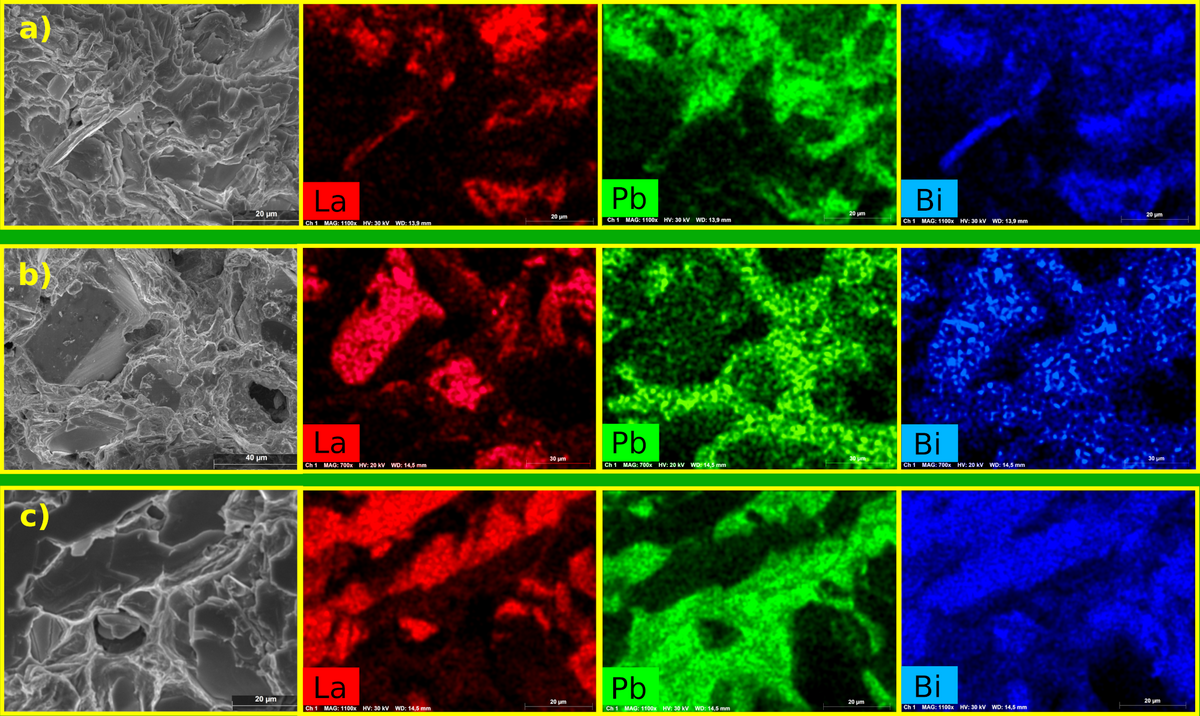
LOW MELTING TEMPERATURE LANTHANUM-LEAD-BISMUTH ALLOYS
Abdul Mannan Majeed1, Sandra Stanionytė2, Gediminas Kreiza3, Šarūnas Vaitekonis4, Vidmantas Kalendra5, Patrik Ščajev6, Algirdas Mekys7
1 Vilnius University, Faculty of Physics, Institute of Photonics and Nanotechnology, Lithuania
2 Center for Physical Science and Technology, Lithuania
3 Vilnius University, Institute of applied electrodynamics and telecommunications, Lithuania,
Acknowledgments: This research was funded by the Research Council of Lithuania, project No S-MIP-24-81.
[1] A. P. Drozdov et al., “Superconductivity at 250 K in lanthanum hydride under high pressures,” Nature, vol. 569, no. 7757, pp. 528–531, May 2019, doi: 10.1038/s41586-019-1201-8.