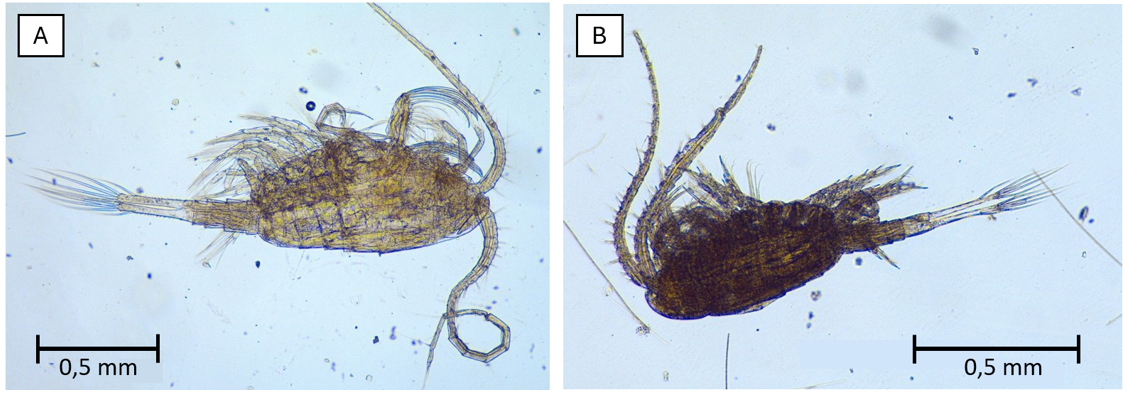
Two species of glacial relict calanoid crustaceans, Limnocalanus macrurus (Sars G.O., 1863) and Eurytemora lacustris (Poppe, 1887) (Fig. 1), are still found in Lithuanian lakes of glacial origin [1]. These species are of considerable scientific interest. The status of their populations may provide valuable information about the ecological condition of lakes. In addition, relict crustaceans constitute an important part of the trophic web, serving as food for fish and significantly contributing to fish production [2]. Unfortunately, the survival of these crustaceans is threatened by eutrophication and global warming [3].
The aim of this work was to summarize available information and to investigate the distribution and abundance of L. macrurus and E. lacustris in Lithuanian lakes.
The research material was collected in 2022 and 2025 using two plankton nets of different diameters and analyzed under a stereomicroscope. Analysis of the material collected in 2022 revealed that relict calanoids inhabited all 22 studied lakes: L. macrurus was found in 14 lakes, while E. lacustris was recorded in 8 lakes. Relict calanoid crustaceans were detected in all their historically known habitats. In addition, new habitats were identified: L. macrurus was recorded in Lakes Juodieji Lakajai and Žeimenys, whereas E. lacustris was found in Lakes Alaušas, Avilys, and Galstas.
In 2025, previously unstudied lakes — Virintai, Smalvos, Sartai, and Drūkšiai — were examined to determine the presence of relict calanoid crustaceans. In addition, two previously studied lakes, Avilys and Žeimenys, were re-examined to confirm the presence of relict calanoids and to assess the abundance of their populations.
The results indicate that Lithuanian lakes remain insufficiently investigated, as new habitats of relict calanoid crustaceans continue to be discovered. Consequently, more comprehensive and systematic research is required to accurately assess the status of these species’ populations in Lithuania.