
Bacteria and archaea use CRISPR (clustered regularly interspaced short palindromic repeats) to defend against bacteriophages by targeting foreign nucleic acid for degradation. In type I CRISPR systems, the crRNA guide is bound and directed by the Cascade effector complex [1]. The Cascade complex recognizes the PAM sequence on the target DNA and identifies the target by formation of the R-loop structure – a three-stranded nucleic acid structure, composed of a DNA-RNA hybrid and the displaced non-target single-stranded DNA. The formation of a stable R-loop is a crucial step in the CRISPR mechanism because it permits recruitment of the nuclease-helicase Cas3, which initiates degradation of the target DNA [Fig. 1], [2]. 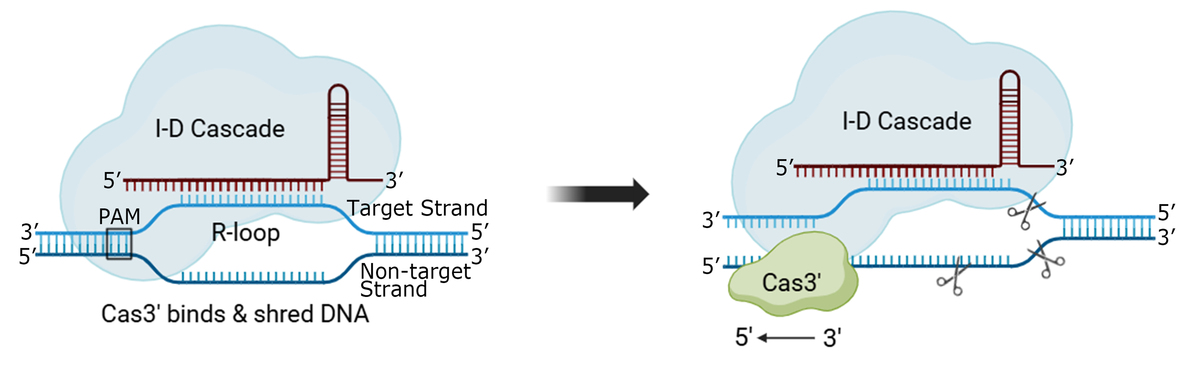
MECHANICS OF R-LOOP FORMATION BY CASCADE STUDIED WITH MAGNETIC TWEEZERS
Virginija Siaurusevičiūtė1, Ugnė Gaižauskaitė1, Gabija Naujokaitė1, Inga Songailienė1, 2, Algirdas Toleikis1
1 Vilnius University, Life Sciences Center, Saulėtekio al. 7, LT- 10257 Vilnius, Lithuania
2 University of Copenhagen, Novo Nordisk Foundation Center for Protein Research, Blegdamsvej 3B, DK-2200 Copenhagen, Denmark
[1] Y. Zheng et al., “Endogenous Type I CRISPR-CAS: From foreign DNA defense to prokaryotic engineering,” Frontiers in Bioengineering and Biotechnology, vol. 8, p. 62, Mar. 2020, doi: 10.3389/fbioe.2020.00062.
[2] K. Yoshimi et al., “Dynamic mechanisms of CRISPR interference by Escherichia coli CRISPR-Cas3,” Nature Communications, vol. 13, no. 1, p. 4917, Aug. 2022, doi: 10.1038/s41467-022-32618-0.