APPLICATION OF DIBENZOFURAN-BASED HOST MATERIALS FOR BLUE 3RD GENERATION THERMALLY ACTIVATED DELAYED FLUORESCENCE (TADF) ORGANIC LIGHT EMITTING DIODES
Goda Grybauskaitė1, Kristupas Bagdonas1, Domantas Berenis1, Gediminas Kreiza1, Edvinas Orentas2, Eigirdas Skuodis3, Karolis Kazlauskas1, Dovydas Banevičius1
1 Vilnius University, Faculty of Physics, Institute of Photonics and Nanotechnology, Vilnius, Lithuania
2 Vilnius University, Faculty of Chemistry and Geosciences, Department of Organic Chemistry, Vilnius, Lithuania
3 Kaunas University of Technology, Faculty of Chemical Technology, Department of Polymer Chemistry and Technology, Kaunas, Lithuania
Over the past decade, intensive research has been carried out on organic light-emitting diodes (OLEDs) employing thermally activated delayed fluorescence (TADF) emitters, which enable achieving 100% internal quantum efficiency [1]. While green and red OLEDs used in industry exhibit excellent efficiency and operational stability, blue devices still suffer from unresolved stability issues [2]. One possible approach to improving the stability of blue emitters is the synthesis and incorporation of new host materials into the device structure. The emitter molecules are dispersed in a host matrix to suppress concentration quenching and enhance charge transport. Importantly, the triplet energy level of the host material must be higher than that of the emitter to prevent reverse energy transfer from the emitter back to the host [3–4].
The aim of this study was to evaluate the suitability of three newly synthesized dibenzofuran-based host materials—A0, A1, and A2—for the fabrication of efficient and stable blue TADF OLEDs. The triplet energy levels of the host materials were determined using absorption and photoluminescence measurements, while the optimal concentration of the emitter DMeCzIPN [5] was established based on photoluminescence quantum yield (PLQY) measurements. The OLED devices were fabricated by vacuum deposition and subsequently electrically and optically characterized.
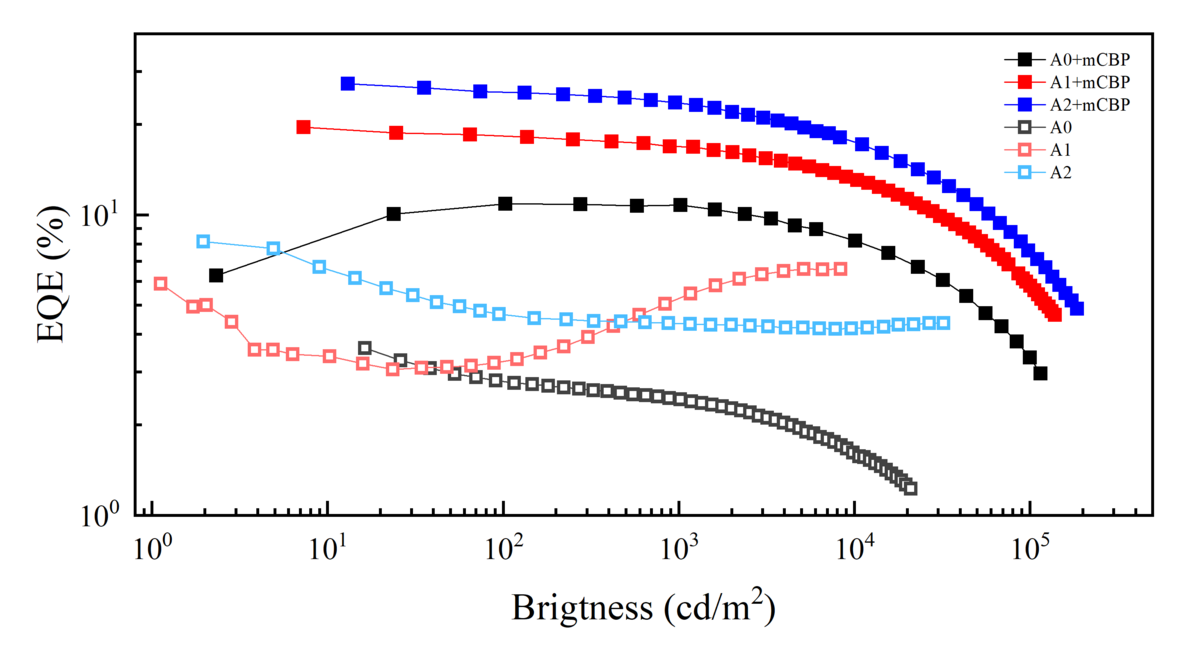
It was found that the triplet energies of hosts A0 and A1 are similar to that of the emitter, while A2 possesses a higher triplet energy. The optimal emitter concentration in all hosts was 20%. The devices achieved a maximum EQE of 8.1% and an LT\(_{50}\) of 2.5h at ~1000 cd/m², likely limited by crystallization of the organic layers. At low voltages, a broad green emission was observed due to exciplex formation between DMeCzIPN and the adjacent Tris-PCz layer. Introducing a 10 nm mCBP interlayer suppressed exciplex formation, significantly improving efficiency to EQE = 27% and extending LT\(_{50}\) to 11h, while also reducing crystallization effects.
Fig. 1. External quantum efficiency curves as a function of brightness for OLEDs with A0, A1, and A2 host materials.
[1] H. Uoyama, K. Goushi, K. Shizu, H. Nomura, and C. Adachi, “Highly efficient organic light-emitting diodes from delayed fluorescence,” Nature, vol. 492, no. 7428, pp. 234–238, Dec. 2012, doi: https://doi.org/10.1038/nature11687.
[2] D. Banevičius, G. Puidokas, G. Kreiza, S. Juršėnas, E. Orentas, and K. Kazlauskas, “Prolonging blue TADF-OLED lifetime through ytterbium doping of electron transport layer,” Journal of Industrial and Engineering Chemistry, vol. 128, pp. 515–520, Aug. 2023, doi: https://doi.org/10.1016/j.jiec.2023.08.016.
[3] Eglė Tankelevičiūtė, Samuel, and E. Zysman-Colman, “The Blue Problem: OLED Stability and Degradation Mechanisms,” The Journal of Physical Chemistry Letters, vol. 15, no. 4, pp. 1034–1047, Jan. 2024, doi: https://doi.org/10.1021/acs.jpclett.3c03317.
[4] M. Y. Wong and E. Zysman-Colman, “Purely Organic Thermally Activated Delayed Fluorescence Materials for Organic Light-Emitting Diodes,” Advanced Materials, vol. 29, no. 22, p. 1605444, Mar. 2017, doi: https://doi.org/10.1002/adma.201605444.
[5] G. Kreiza et al., “High efficiency and extremely low roll-off solution- and vacuum-processed OLEDs based on isophthalonitrile blue TADF emitter,” Chemical Engineering Journal, vol. 412, p. 128574, May 2021, doi: https://doi.org/10.1016/j.cej.2021.128574.