
In the last decades, one major topic of research is Two-Photon Lithography, which is a non-linear laser direct writing technique that is based on two-photon absorption phenomenon [1]. It provides high resolution with sub-diffraction features and it can be used to create complex, true 3D-printed micro and porous structures [2], without the need of using masks.[3] TPL is often used for the fabrication of different geometries, like foams. High porosity foams have many applications in optics and photonics, biology, mechanics, acoustics, electronics etc.[1]
One of the properties that make them really significant is their ability to produce plasma during Inertial Confinement Fusion (ICF) [4], which is is a method of achieving nuclear fusion by using lasers or other energy sources to compress and heat a small fuel pellet until it implodes and fuses. The main requirements of the microstructures in order to be used as targets, are low and uniform density [5], as well as the absence of more heavy elements than Carbon. 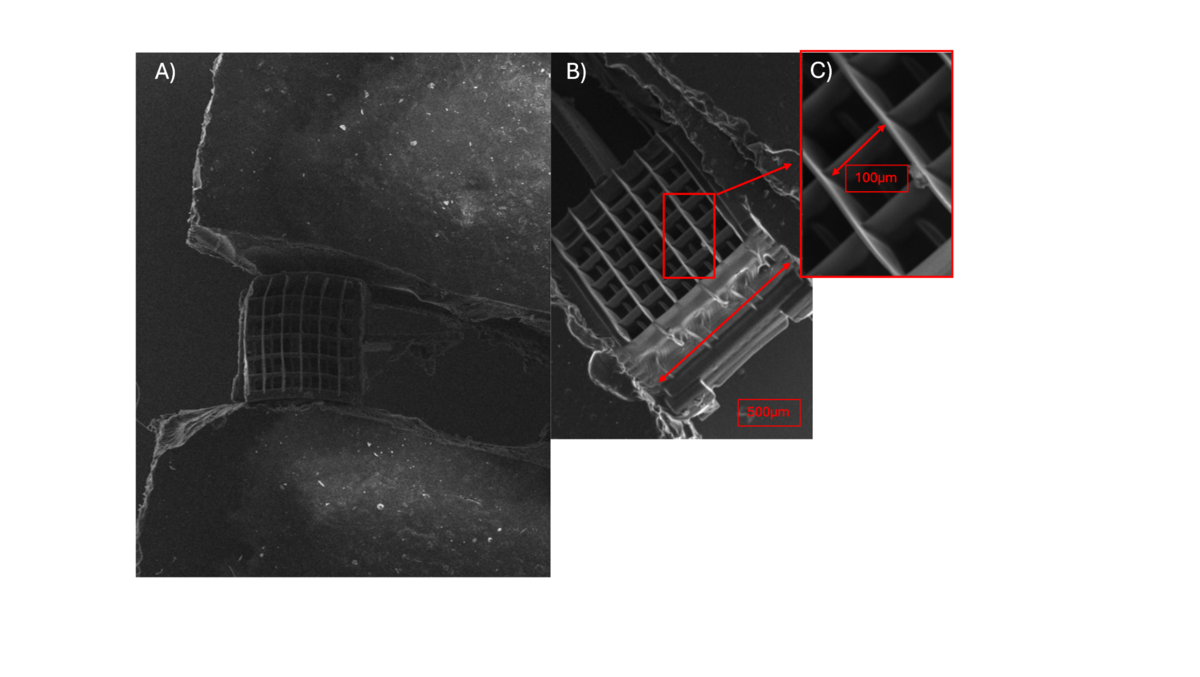
The aim of this work is to fabricate low-density woodpile geometry foams of acrylate materials using TPL, employing a 517 nm femtolaser source. To achieve this, laser power and scanning speed parameters were optimized to ensure the fabrication of stable, reproducible microstructures with high resolution. Specifically, the materials that were used were (PETA:PETTA)(60:40) and photoinitiator 0.5% thioxanthone-9h, which is a chemical compound that absorbs light and produces reactive species, such as free radicals, to initiate polymerization. The achieved density was 0.07% g/cm3. Mechanical characterization was performed using Atomic Force Microscopy (AFM) by Maria Frasari and her colleagues at IESL-FORTH with data analysis currently ongoing. Finally, the woodpiles were integrated into a 3D printed holder, which is easy handling during ICF experiments, that will be conducted at ABC group of ENEA in Frascati by dr. Mattia Cipriani.