Terahertz (THz) frequency range of the electromagnetic (EM) wave spectrum is known for its ability to pass through dielectric materials, that are otherwise non-transparent to visible light, such as plastic, paper, wood or textile, makes THz radiation a great tool in identifying and locating packed objects [1]. However, application of THz imaging systems is limited due to the absence of compact, efficient, and cost-effective solid-state emitters. Currently available solutions are expensive, suffer from limited operation frequency range and are of intricate structure [2]. As an alternative specifically tailored thermal radiation could be used, allowing for the mitigation of the above mentioned limitations. Here the semiconductor structures, particularly, devices comprising conductive/insulating/conductive layers structure, equipped with metasurfaces, could be used [3]. Such emitters can be operated at elevated temperatures, are of relatively simple inner structure, do not require additional expensive and usually bulky equipment and can provide thermal emission tailored to spectrally narrow resonant lines [4].
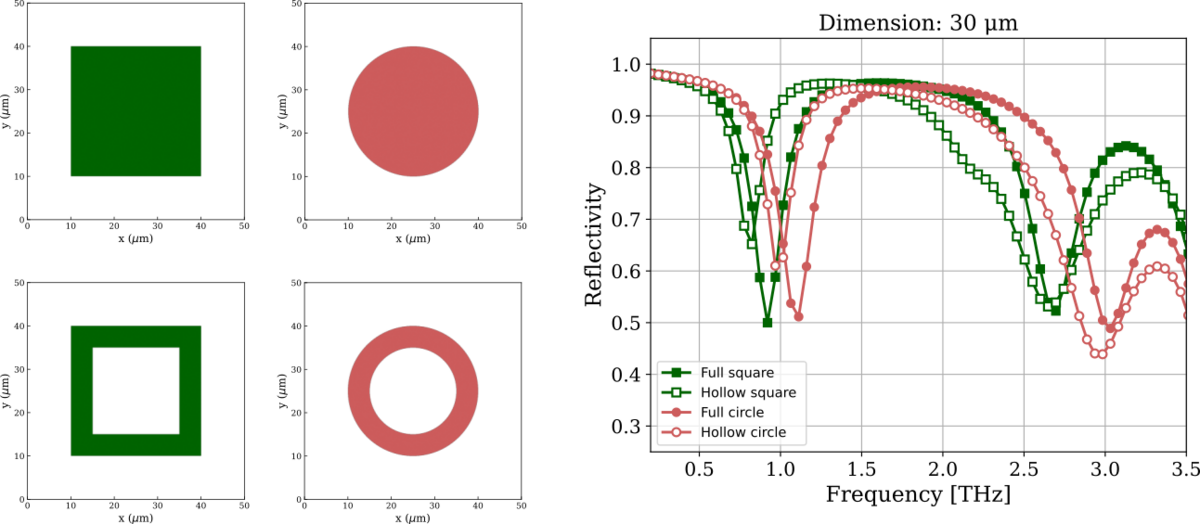
In this work the electromagnetic properties of GaAs-based conductor/insulator/conductor structures equipped with metasurfaces comprising either circular or square-shaped metacells are numerically simulated and investigated. The structures were simulated using Rigorous Coupled Wave Analysis (RCWA) [5] method and consisted of n-GaAs substrate, 4.3 µm thick GaAs insulator layer and 200 nm thick Ti/Au metasurface layer. The metasurface consisted of full or hollow metal metacells shaped like either squares or circles (Fig. 1) with dimensions (side length, diameter) varying from 20 µm to 40 µm. To compare the properties of differently shaped metacells the reflectance spectra, dielectric permittivity, magnetic susceptibility and EM field distribution throughout the structures were simulated.
Acquired reflection spectra (Fig. 1) showed that when the diameter of a circle matched the side length of the square metacell, the disk-shaped metasurface exhibited higher resonance frequency compared to the square-shaped one. It was noted that the increase in dimensions across all types of metacell configurations resulted in lower resonance frequency. Additionally, comparison of hollow and full shaped metacells, showed that by taking out a center part of the metal leads to EM field concentration mainly at the surface as opposed to the full metacells, where field distribution is more prominent throughout the whole structure. However, the resonance frequency values remained comparable, with the hollow-shaped metacells shifting slightly to lower frequencies.