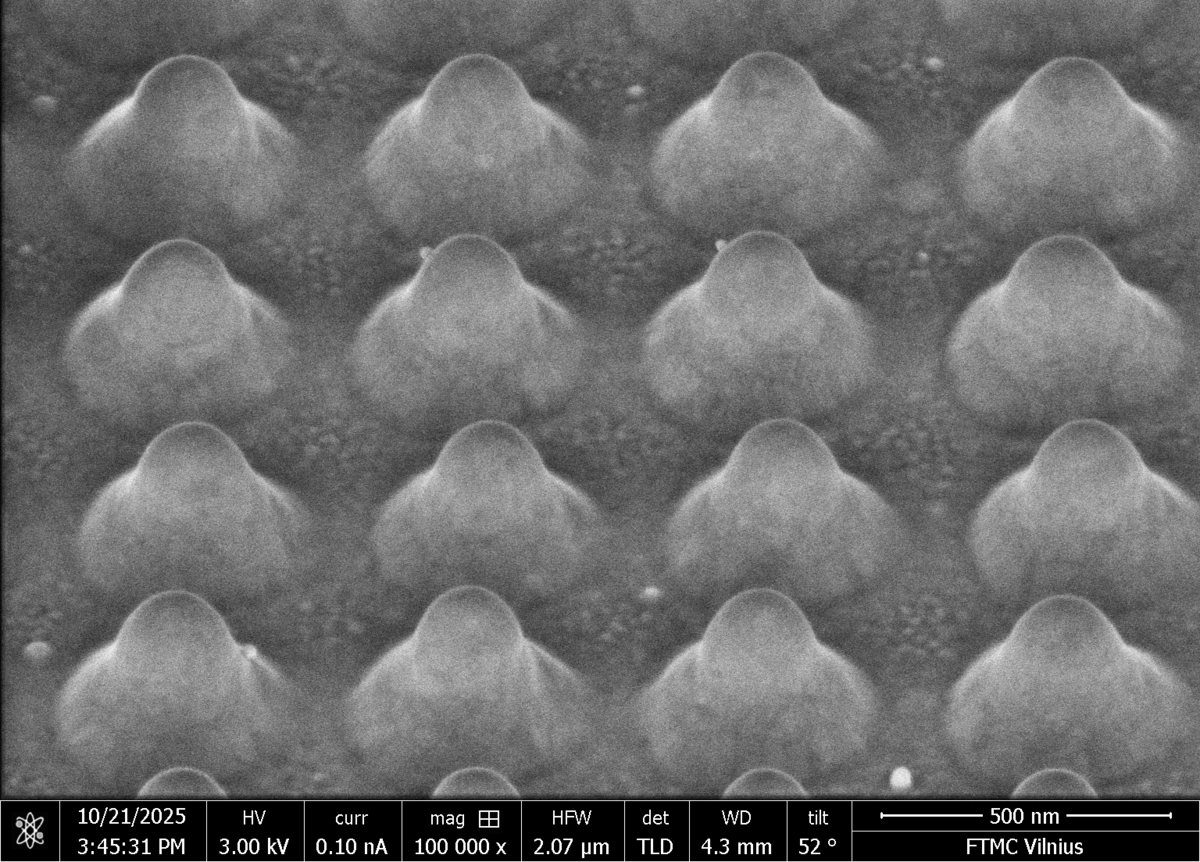
Plasmonic gratings and arrays composed of noble metals are actively studied due to their ability to support strong light–matter interactions and surface plasmon excitation. Such properties enable applications ranging from spectroscopy and sensing to photovoltaics and functional surface design [1]. These effects originate from plasmonic resonance, which occurs when incident light excites collective oscillations of free electrons at the metal surface. Since the momentum of incident photons is insufficient to directly couple to surface plasmons, additional momentum matching is required. This can be achieved by structuring the metal surface with wavelength-comparable features that act as a diffraction grating [2], enabling efficient light–plasmon coupling and the excitation of localized surface plasmon resonances (LSPR).
In this study, plasmonic nanostructures are formed using direct laser writing on glass substrates coated with silver–gold alloy films. Alloy compositions with silver-to-gold ratios of 50/50 and 80/20 and a coating thickness of 100 nm are investigated. The laser-induced surface patterning enables the formation of periodic structures with dimensions comparable to the excitation wavelength, which induces LSPR excitation. The plasmonic properties of the fabricated structures are analyzed using reflectance spectra measured under different polarization conditions in the visible to near-infrared spectral range. This work demonstrates that silver–gold alloy thin films can be effectively structured to support plasmonic resonances, highlighting their potential for tunable plasmonic devices and practical applications.