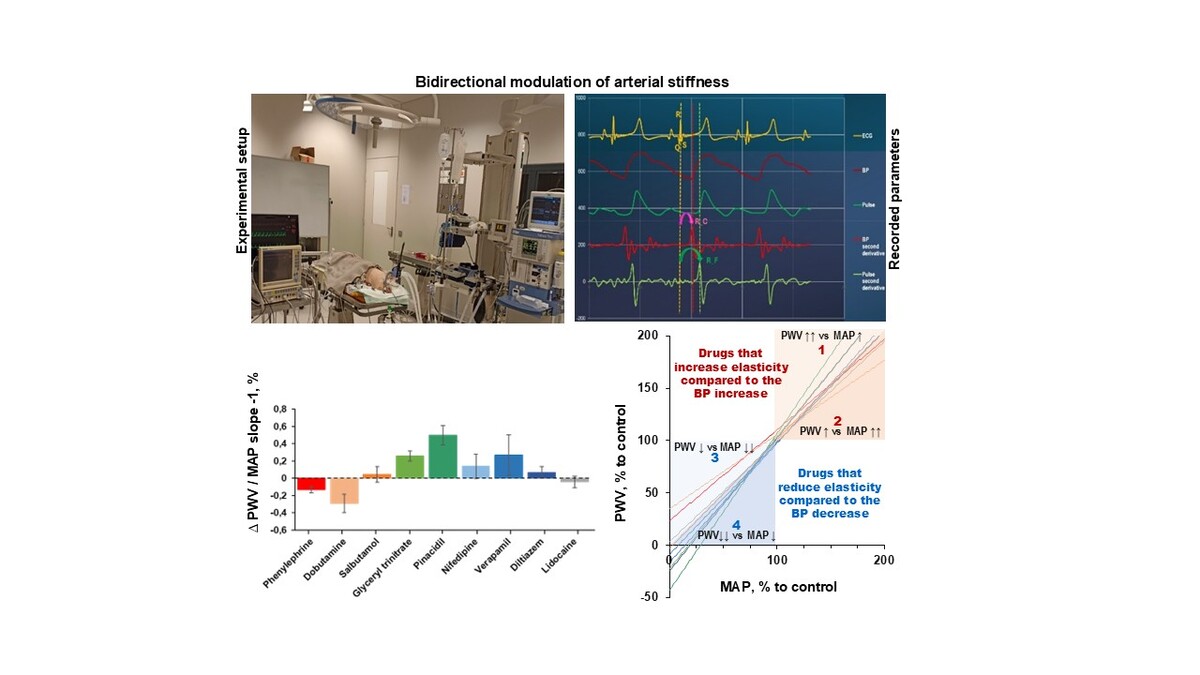
Arterial stiffness, recognized as a marker of vascular aging, may also be influenced by various cardioactive drugs. However, the relationship between blood pressure and stiffness caused by different drugs has not yet been thoroughly characterized.
In anesthetized healthy pigs, the acute hemodynamic effects of nine vasoactive substances were systematically evaluated (Fig.1). A single intravenous bolus of each drug was administered via the ear vein, with measurements taken at peak, 5, and 30 minutes post-injection (n=3-5). Real-time measurements of systolic, diastolic, and mean arterial pressure (MAP), pulse pressure, heart rate, and carotid-femoral pulse wave velocity (PWV) were recorded and normalized to baseline. PWV was further normalized to MAP (PWV/MAP) to enable intergroup comparisons of the drug effects, revealing how the induced changes in blood pressure depend on vascular elasticity.
All compounds produced distinct, reproducible short-term hemodynamic profiles. α1 and β1 adrenergic stimulation increased PWV, whereas vasodilators and a β2-agonist decreased it. Regression modelling enabled us to evaluate the relationship between blood pressure and stiffness under different drug administrations. This study shows that arterial stiffness is dynamically regulated. We analysed how substances affecting hemodynamic properties can regulate blood pressure and vascular elasticity.