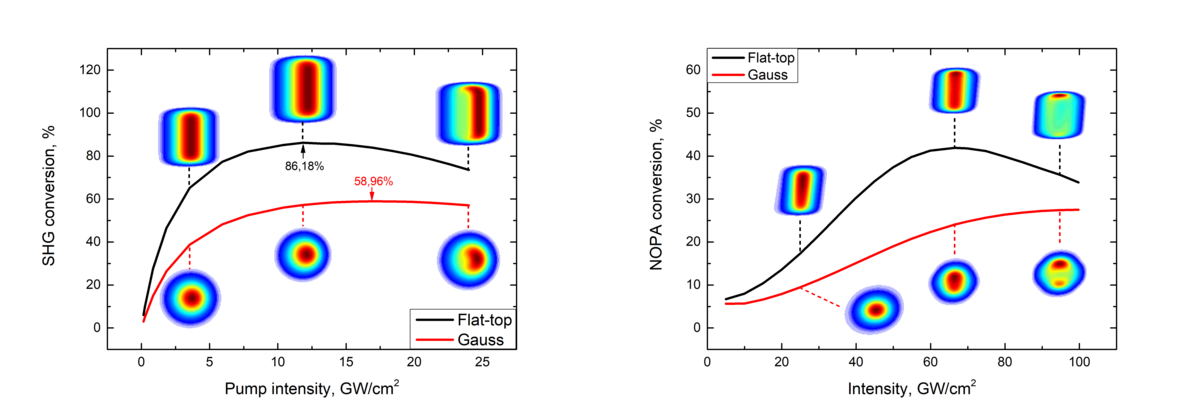
Efficient frequency conversion in nonlinear optics is essential for high-intensity laser systems, particularly in second harmonic generation (SHG) and optical parametric amplification (OPA). While Gaussian beams are commonly used due to their natural formation in laser resonators, flat-top (super-Gaussian) beams provide more uniform nonlinear interaction and improved energy conversion [1],[2]. This study aims to investigate how the spatial profile of the pump beam influences energy conversion efficiency in SHG and OPA processes.
Numerical simulations of three-wave nonlinear interactions using the CHI2D split-step propagation code were performed, coupled by custom Python code for pulse energy evaluation. SHG and degenerate OPA processes in beta-barium borate (BBO) crystals were modeled under varying pump intensities for Gaussian and 10th-order flat-top beams. Experimentally, a femtosecond Yb:KGW laser system (1030 nm, 300 fs) was used. Flat-top beams of 6th, 8th, and 10th super-Gaussian order were generated using a spatially varied wave plate (SVWP) with polarization control. Conversion efficiencies were measured for SHG and compared across beam profiles.
Simulations showed that flat-top beams significantly increased conversion efficiency compared to Gaussian beams. In SHG, the maximum simulated efficiency reached 86.18% for flat-top beams versus 58.96% for Gaussian beams, representing a 27.22% improvement. In OPA, flat-top pumping yielded a maximum efficiency of 41.89%, compared to 27.50% for Gaussian beams, corresponding to a 14.39% increase. Experimentally, SHG measurements demonstrated a 13.49–14.38% higher conversion efficiency for flat-top beams relative to Gaussian beams, with similar conversion achieved at substantially lower peak intensities. Although absolute efficiencies were lower than simulated values due to practical limitations such as phase mismatch and self-action effects, the observed trends were consistent with numerical predictions.
Flat-top pump beams enhance nonlinear conversion efficiency in both SHG and OPA compared to Gaussian beams, particularly by achieving higher efficiency at lower peak intensities.