
The increasing prevalence of antibiotic-resistant foodborne pathogens highlights the urgent need for novel, non-toxic antimicrobial approaches. Antimicrobial photodynamic inactivation (API) is one such technology that is effective against a variety of pathogens that traditional disinfectants and preservatives have trouble with. API relies on three main components: a photosensitizer (PS), molecular oxygen, and light of an appropriate wavelength that corresponds with the absorption spectrum of the PS. Upon photoexcitation, the PS becomes photochemically active, generating reactive oxygen species (ROS) that cause lethal oxidative damage to microbial cellular components [1]. Since API performance hinges on PS physicochemical stability, shifts in absorption or aggregation behavior can directly compromise ROS generation, underscoring the importance of long-term stability. The present work aims to analyse how these conditions influence the spectral profiles of RF/Mg-Chl mixture, studying filtered and unfiltered aqueous systems and allowing the observation of aggregation effects as well as the influence of solution homogeneity on the recorded absorption spectra. 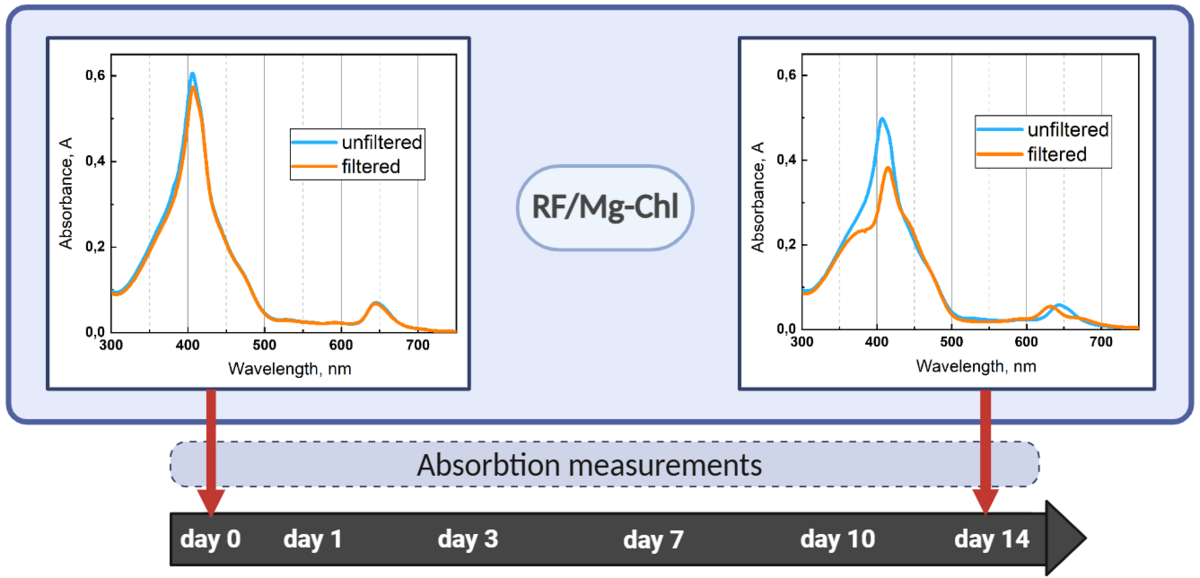
TIME-DEPENDENT STABILITY AND OPTICAL PROPERTIES OF RIBOFLAVIN AND MAGNESIUM CHLOROPHYLLIN MIXTURE IN SOLUTION
Urtė Mitrofanaitė1, Irina Buchovec2
1 Vilnius University, Life Sciences Center, Institute of Biosciences, Vilnius, Lithuania
2 Vilnius University, Faculty of Physics, Institute of Photonics and Nanotechnology, Vilnius, Lithuania
Fig. 1. Scheme of RF/Mg-Chl mixture absorption spectra monitoring in filtered and unfiltered systems over time.
[1] I. Buchovec, E. Vyčaitė, K. Badokas, E. Sužiedelienė, and S. Bagdonas, “Application of Antimicrobial Photodynamic Therapy for Inactivation of Acinetobacter baumannii Biofilms,” International Journal of Molecular Sciences, vol. 24, no. 1, p. 722, Dec. 2022.