
Photoluminescent gold nanoclusters (Au NCs), composed of several to tens of gold atoms, represent a distinct class of quantum-sized nanomaterials exhibiting long-lived excited states, size-dependent electronic structure, and high colloidal stability. Their increasing use in biomedical and environmental applications highlights the need for integrated studies linking physicochemical characterization with biologically relevant effects under realistic exposure conditions. Strong red photoluminescence centered at 680–700 nm with an average lifetime of 1.4 μs was preserved for several weeks in aqueous and buffered media, indicating effective suppression of fluorescence quenching. Integration of Au NCs also enhanced saturation magnetization and increased the blocking temperature, demonstrating cooperative optical–magnetic behavior. 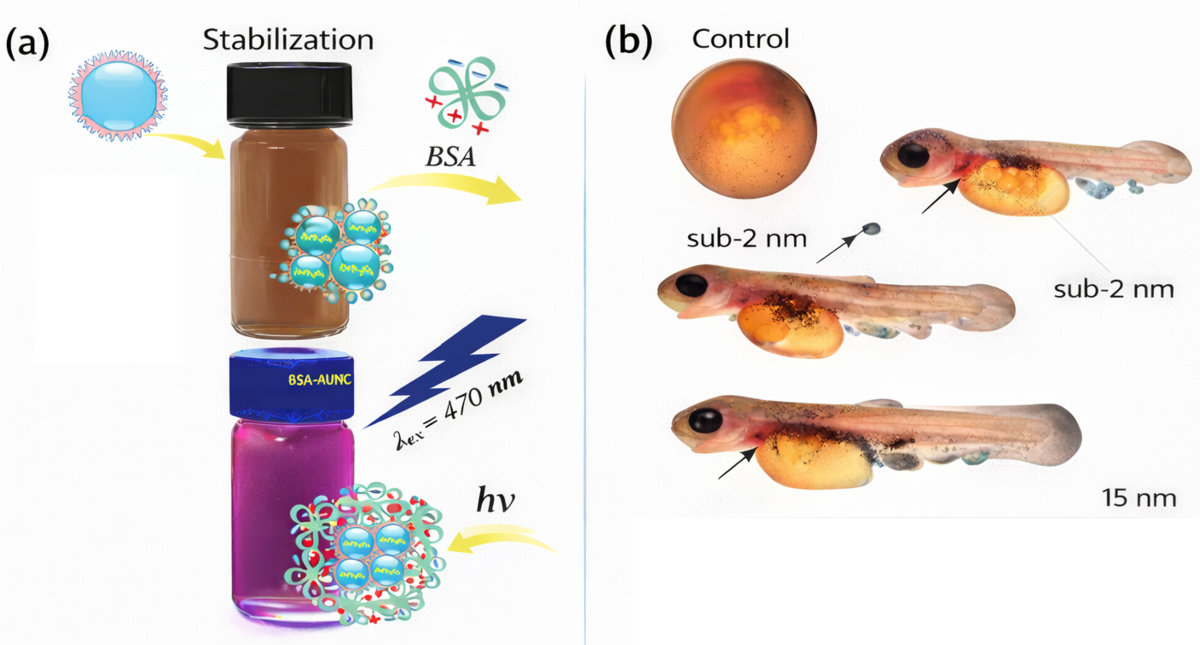
To evaluate biological relevance, the effects of Au NCs were investigated using aquatic primary producers and consumers as model organisms. The freshwater green alga Desmodesmus communis and the cladoceran Daphnia magna were exposed to varying concentrations of Au NCs in standard laboratory media and in natural river water. In D. communis, Au NCs induced time- and concentration-dependent alterations in growth dynamics, colony structure, and photosynthetic pigment composition. After 96 h exposure, changes in chlorophyll a and carotenoid content accompanied by increased malondialdehyde levels indicated oxidative stress and membrane lipid peroxidation, with stronger effects observed in natural water matrices. In D. magna, Au NC exposure resulted in significant sub-lethal physiological and behavioral responses, including altered heart rate, swimming velocity, and total movement distance after 24–48 h. Behavioral endpoints proved more sensitive than acute toxicity, revealing early neurophysiological stress responses.
Overall, the combined physicochemical characterization and multi-species biological assessment demonstrate that the behavior and effects of Au NCs are governed by their quantum-scale structure, surface chemistry, and environmental context. These findings underscore the importance of integrating advanced nanomaterial characterization with environmentally relevant bioassays for realistic risk assessment and safe-by-design development of photoluminescent nanomaterials.