α-Synuclein is a small protein that can be found in the neurons of the central and peripheral nervous system. In Parkinson‘s disease, α-syn adopts a β-sheet conformation that, with additional monomers, forms oligomers and amyloid fibrils [1]. The accumulation of amyloid aggregates is associated with neuronal dysfunction. The search for compounds that inhibit α-synuclein aggregation is one approach to treating the disease. Such compounds range from small molecular-weight substances to complex drug mixtures. Work has been done to analyze the potential of a small-molecular-weight compound group, called imidazo[2,1-b][1,3]thiazines [2].
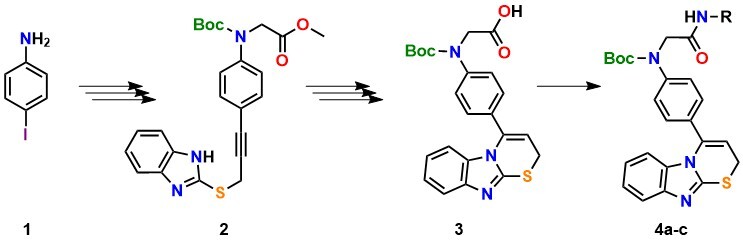
The purpose of this research is to synthesize modified imidazo[2,1-b][1,3]thiazines for further investigation of amyloid modulators. In this work, 4-iodoaniline is treated with di-tert-butyldicarbonate to introduce the tert-butoxycarbonyl (Boc) group. The nitrogen atom of the obtained product is alkylated with ethylbromoacetate. Then iodine is replaced with propargyl alcohol using the Sonogashira method, and the resulting product is brominated to replace the hydroxy group. During nucleophilic substitution, bromine is replaced with thiobenzimidazole. In the next step of cyclization, imidazo[2,1-b][1,3]thiazine is formed. In this work, the obtained product is modified in several steps with different amines, yielding amides.
During this research several N-substituted 2-((4-(benzimidazo[2,1-b][1,3]thiazin-4-yl)phenyl)(Boc)amino)acetamides were synthesized. The compounds will be further analyzed to determine their effectiveness in modulating amyloid aggregation.