
Hsp90 (Heat Shock Protein 90) is a molecular chaperone of the heat shock protein family that ensures proper protein folding, stabilizes proteins under stress conditions, and facilitates their degradation. While it constitutes 1-2% of all protein content in healthy human cells, cancer cells contain elevated levels of this protein [1]. Studies have shown that Hsp90 plays a key part in migration, metastasis, and other aspects of tumour progression. Consequently, over the last decade, Hsp90 has been thoroughly investigated as a potential target for anticancer treatments [2].
Research on natural compounds has found that resorcinol (1) is essential for a molecule to bind to the N-terminal domain of Hsp90. This region contains the ATP-binding pocket, which is vital for the protein’s function. Further studies have shown that an aromatic ring near the resorcinol moiety greatly enhances the binding characteristics of Hsp90 inhibitors [3]. While many different compounds have been synthesized, the 4th position of the resorcinol ring is comparatively underexplored.
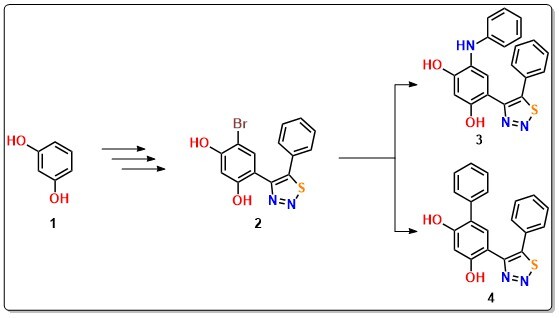
This work aimed to synthesize a range of Hsp90 inhibitors with hydrophobic substituents at the 4th position of the resorcinol fragment. Utilizing palladium chemistry, two different types of compounds were obtained using Buchwald-Hartwig (3) and Suzuki (4) coupling reactions with phenylamino and phenyl groups, respectively. The presentation will cover the divergent synthesis process, its challenges, and results.