Triplet-triplet annihilation upconversion (TTA-UC) converts two low-energy photons into a single higher-energy photon in a paired sensitizer-annihilator system. After absorbing low-energy excitation light, the sensitizer generates a triplet exciton via intersystem crossing and transfers this energy to the annihilator through triplet-energy transfer. When two triplet-excited annihilators interact, one returns to the ground state while the other can form an excited singlet state. The emission from this state results in a photon of higher energy than that of excitation. [1]
Efficient TTA-UC depends on the long lifetime of triplet excitons. However, dissolved molecular oxygen under ambient conditions strongly quenches these triplet states, reducing upconversion emission and complicating the assessment of intrinsic photophysical parameters. [2] Traditional deoxygenation methods, such as inert-gas bubbling, freeze-pump-thaw cycles, or sample preparation in an oxygen-free environment (e.g., glovebox), are effective but time-consuming and require specialized equipment.
Chemical oxygen scavengers offer an alternative approach by irreversibly removing molecular oxygen through chemical reactions. After quenching the triplet state, molecular oxygen forms reactive singlet oxygen, which, in the presence of scavengers, reacts efficiently to produce stable oxidized products, thus lowering dissolved oxygen concentration.
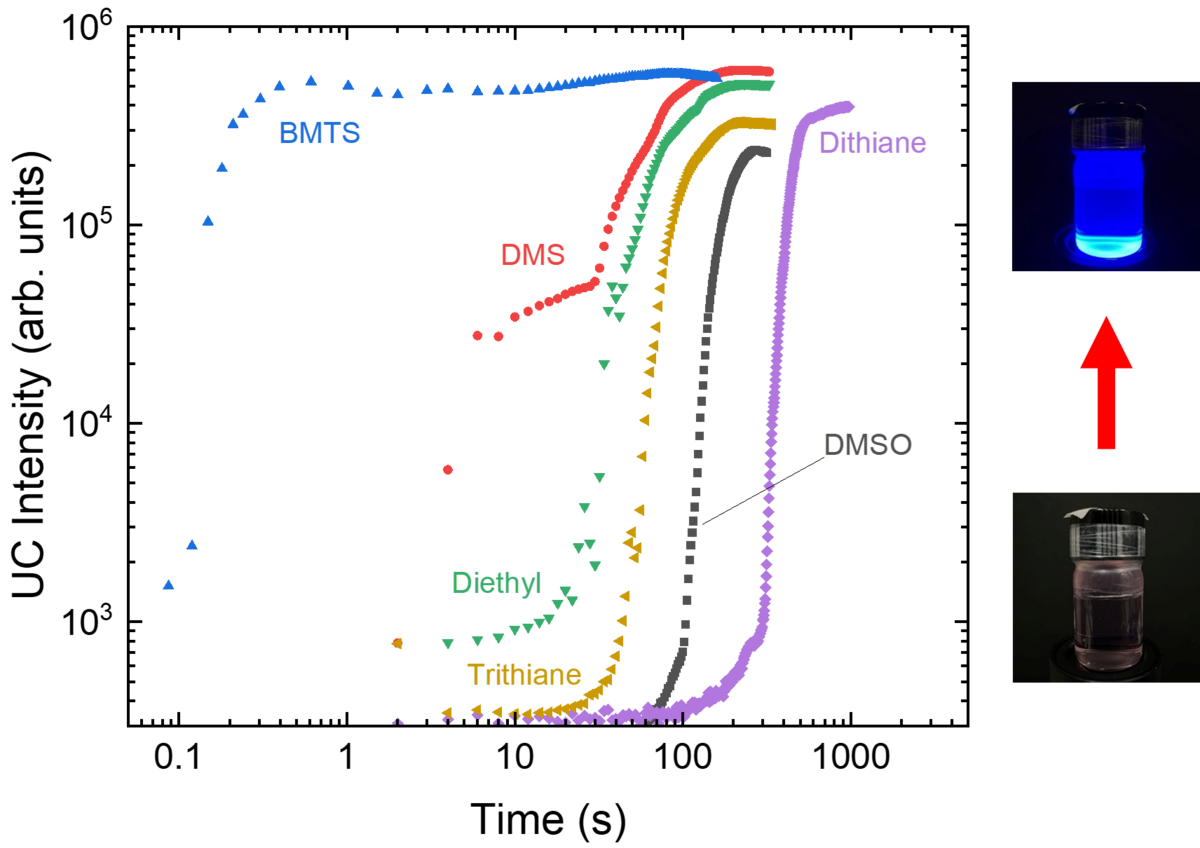
In this work, various sulfur-based oxygen scavengers were investigated by measuring the emission onset of upconverting solutions under UV and 532 nm excitation. The compound containing three sulfur atoms (bis(methylthiomethyl) sulfide, BMTS) exhibited almost instant upconversion with an onset time of <1 s and a strong emission intensity.
The work examines the influence of the BMTS scavenger on UC quantum yields and lifetimes and determines the optimal scavenger concentration in the prepared TTA-UC solutions. The results of short- and long-term stability studies are also presented, which are essential for the practical application of this scavenger.