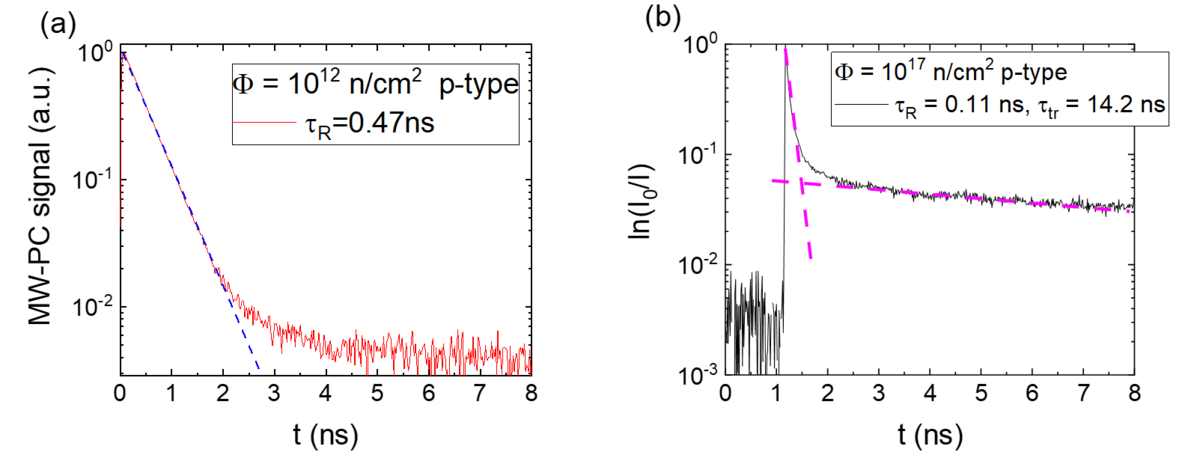
Si is one of the most essential materials in high-tech applications, particularly in the fabrication of radiation-tolerant particle detectors and sensors used in high-energy physics and radiation monitoring. In these fields, the lifetime of non-equilibrium charge carriers is a critical parameter, as it serves as a sensitive indicator of material quality and lattice degradation [1]. Characterizing these recombination kinetics is essential for predicting the operational reliability and functional limits of semiconductor devices operating in harsh radiation environments.
In this work, Si samples were irradiated in the TRIGA Mark II reactor to induce displacement damage through the creation of primary Frenkel pairs and stable defect complexes, such as vacancies and related compounds [2]. These radiation-induced defects introduce deep energy levels into the bandgap that act as efficient recombination centers, directly dictating the speed of free charge carrier decay. To resolve these characteristics across a wide fluence range \((10^{12}- 10^{17} \, \mathrm{ n/cm^2)}\), two techniques were used. The microwave-probed photoconductivity (MW-PC) method was utilized for lower fluences to monitor nanosecond-range decay. However, at higher fluences, the increased density of recombination centers makes the kinetics ultrafast, exceeding the RC circuit constraints of the MW-PC system. Consequently, a femtosecond laser-based pump-probe (PP) method was required to resolve the picosecond-range kinetics in the most heavily irradiated samples. A comparative analysis of lower and higher irradiated Si was performed: