Polycyclic aromatic compounds are widely studied for photonic and optoelectronic applications because their optical properties strongly depend on their environment. In particular, molecular photoswitches are of significant interest due to their ability to undergo reversible structural changes upon light irradiation. Light-induced isomerization can modify their electronic structure and, consequently, their optical and photophysical properties, enabling potential applications in smart materials and light-controlled devices. Understanding how solvent polarity and solid-state embedding affect such systems is therefore important for the design and usage of future functional materials [1].
The aim of this work was to investigate the photophysical properties of two compounds, NB18 and NB38, in toluene, acetonitrile and a PMMA matrix.
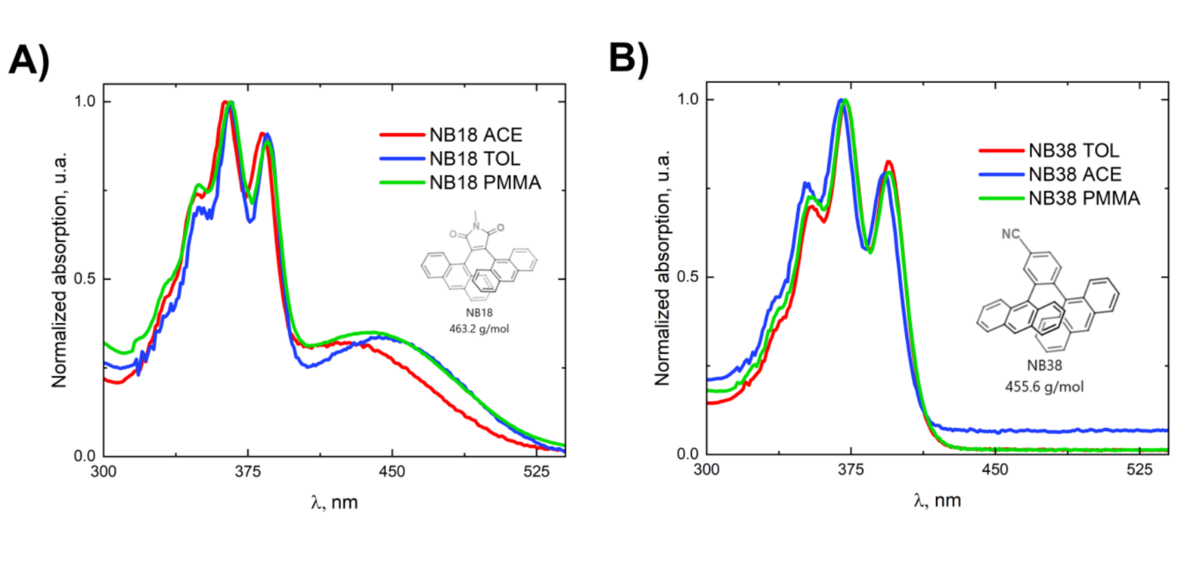
Absorption, fluorescence spectra, quantum yields (QY), fluorescence lifetimes, and femtosecond pump–probe measurements were performed. The main absorption maximum for both compounds was observed near 370 nm (Fig. 1). The results show a clear influence of solvent polarity on the optical properties of both compounds. Changing from polar acetonitrile to less polar toluene led to a significant increase in fluorescence efficiency and lifetime. For example, NB18 exhibited a quantum yield of only 0.13% in acetonitrile, which increased to 5.49% in toluene, while its lifetime increased from 59 ps to 283 ps. Similar trends were observed for NB38, where the compound exhibited moderate QY in both solutions (about 0.3%) and its lifetime increasing from 401 ps in acetonitrile to 591 ps in toluene. NB18 showed a moderate quantum yield in PMMA of (4.97%), while NB38 exhibited a significantly higher value in PMMA (40.67%). Such differences between the solvents and the polymer are drastically different because a more rigid environment does not allow them to rotate freely and thus restricts their motion. Fluorescence lifetimes were shortest in acetonitrile and increased in toluene and PMMA, reaching up to 1173 ps for NB38 in the polymer matrix. Pump–probe experiments showed weak transient signals, especially for NB38, while NB18 displayed clearer early-time dynamics indicating a signal for specific time-frames showing that it reaches an excited state.
These results demonstrate that solvent polarity and matrix immobilization strongly influence the optical efficiency and excited-state behavior of both materials.