Neutral particles such as \(\pi^{0}\) mesons and \(\gamma\) photons are detected with low efficiency and poor resolution in particle detectors due to their lack of electric charge. This is particularly important in large-scale experiments like LHCb, where rare decay channels are investigated, and inefficiencies may cause events to remain undetected or misinterpreted. Therefore, improving reconstruction methods for decays involving neutral particles is essential for reliable physics analyses.
The objective of this work was to investigate and apply the Extended Cone Closure (ECC) method for deterministic reconstruction of missing momentum in heavy baryon decays and to develop visualization tools that enhance the understanding of reconstructed decay topologies. The study focused on the decay channel \[\Lambda_b^{0} \rightarrow \Lambda_c^{+} D^{0} K^{-},\] which is of interest in searches for pentaquark states predicted in the \(\Lambda_c^{+} D^{*0}\) system [1,2].
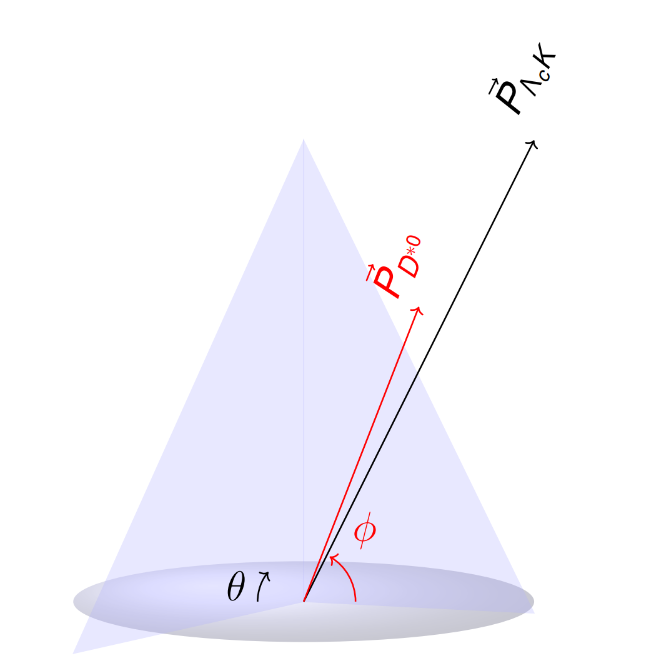
Monte Carlo–simulated \(\Lambda_b\) baryon decay samples were generated using the RapidSim framework and analyzed within the CERN ROOT environment. The Extended Cone Closure (ECC) method reconstructed the momentum of undetected neutral particles by applying energy–momentum conservation and geometric constraints derived from the decay topology. Using known particle masses and vertex information, the method determined the magnitude and direction of the missing momentum by scanning angular solutions and selecting the configuration that best matches the reconstructed \(\Lambda_b^{0}\) flight direction. This allowed full kinematic reconstruction of the decay, despite the absence of direct detection of neutral particles. After confirming that the ECC method reconstructs the missing momentum of \(\Lambda_b\), Python-based tools were used to visualize the reconstructed decays, enabling a more in-depth analysis.
The results demonstrate that the ECC method successfully reconstructs the missing momentum of neutral particles, such as \(\pi^{0}\) mesons, in simulated \(\Lambda_b\) decays. The developed visualization approach provides clear insight into decay geometry and angular correlations of the decay products, enabling more detailed analysis.