For more than a century, fossil fuels such as coal, natural gas and oil have been the world’s main source of energy. But they are constantly running out. This is particularly due to the sharp increase in energy demand and the rapidly growing world population [1]. Scientists are working to find a way to replace this by developing clean, sustainable and efficient energy sources. One alternative is renewable energy from the sun and wind. It can be a sustainable, economical and environmentally friendly source of energy. It can also help reduce greenhouse gas emissions and mitigate the effects of climate change. But this has its drawbacks. Renewable energy from the sun and wind is intermittent. That is, electricity is only produced when the sun is shining or the wind is blowing. For this reason, it is difficult to ensure a constant supply of electricity [2]. The second alternative is hydrogen. Hydrogen is considered a “green” and sustainable energy [3]. It is a high-calorie, clean and environmentally friendly fuel with zero emissions. And during combustion, no greenhouse gases are released and no air pollution occurs, and only water vapor is formed as a by-product [1].
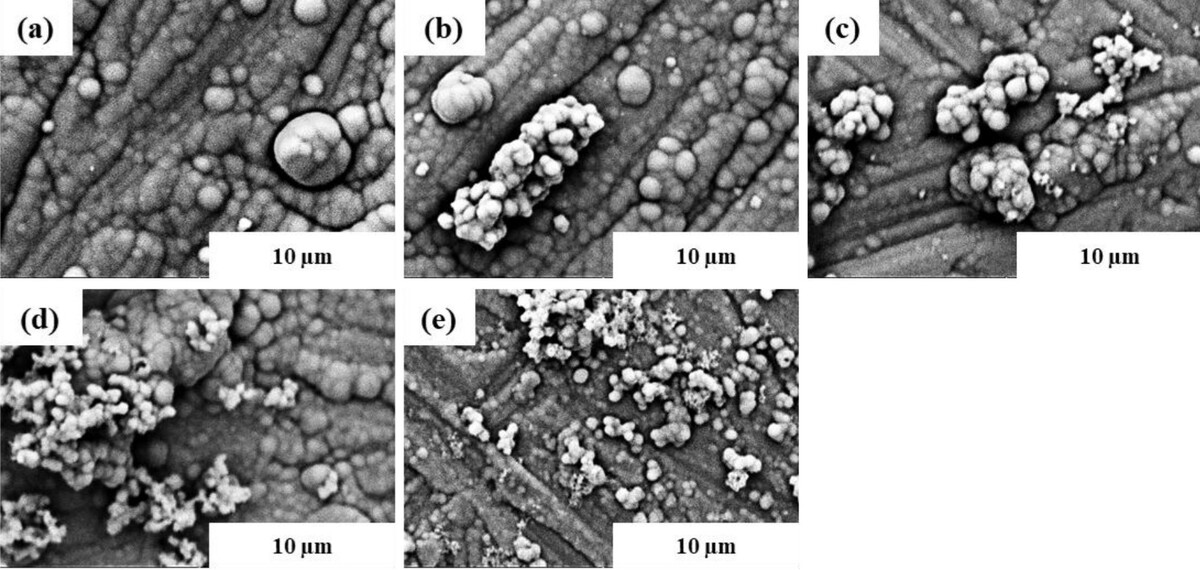
During this work, Ni\(_{93}\)W\(_{7}\)/Cu, Ni\(_{91}\)W\(_{9}\)/Cu, Ni\(_{89}\)W\(_{11}\)/Cu, Ni\(_{87}\)W\(_{13}\)/Cu, and Ni\(_{85}\)W\(_{15}\)/Cu catalysts were formed using the chemical method of metal deposition. The surface morphology, internal structure and chemical composition of the obtained catalysts were analyzed using scanning electron microscopy (SEM) and inductively coupled plasma optical emission spectroscopy (ICP-OES). It was determined that the prepared coating particles consist of oval-shaped agglomerates. The catalytic properties of the formed catalysts for sodium borohydride hydrolysis reaction were investigated. The two-component Ni\(_{93}\)W\(_{7}\) coating was characterized by the highest catalytic activity.