
Vibrations in daily life as well as in engineering often exhibit displacement amplitudes on the order of few micrometers and frequencies in the kilohertz-regime. The characterization of such vibrations poses a challenge, because micrometer displacement amplitudes are close to the lower detection limit for most incoherent full-field topography measurement methods. Regular interferometric techniques on the other hand are more useful for displacements in the nanometer-regime, as the variation in surface height between two frames must be significantly smaller than the optical wavelength to ensure unambiguous results. For displacement amplitudes of several micrometers this means that a large number of frames must be captured for each vibration period. This requires a camera with an excessively high frame rate much higher than the vibration frequencies to be studied.
Synthetic Wavelength Interferometry (SWI) solves this problem by making use of wavelength diversity to extend the unambigous measurement range. Specifically, interferometric measurements at two slightly different optical wavelengths \(\lambda_1\) and \(\lambda_2\) are recorded and evaluated. The phase difference between the two measured complex fields corresponds to the phase of the field at the synthetic wavelength \(\Lambda = \lambda_1\cdot\lambda_2/|\lambda_1-\lambda_2|\). It follows that the synthetic wavelength is tuneable in a wide range by tuning the optical wavelengths in a small range. It can especially be much larger than the optical wavelengths, leading to the desired extended unique measurement range.
By using a fiber-coupled dual off-axis carrier-fringe interferometry setup as sketched in figure 1, single shot SWI can be performed [1]. Each camera frame captures the full complex field information at both wavelengths from which the synthetic wavelength interferogram is calculated. This allows one to study dynamic processes such as vibrations. The synthetic wavelength can be chosen larger than the displacement amplitudes of the sample such that two measurements per vibration period are sufficient. As a result, cameras with a comparatively low frame rate can be used. 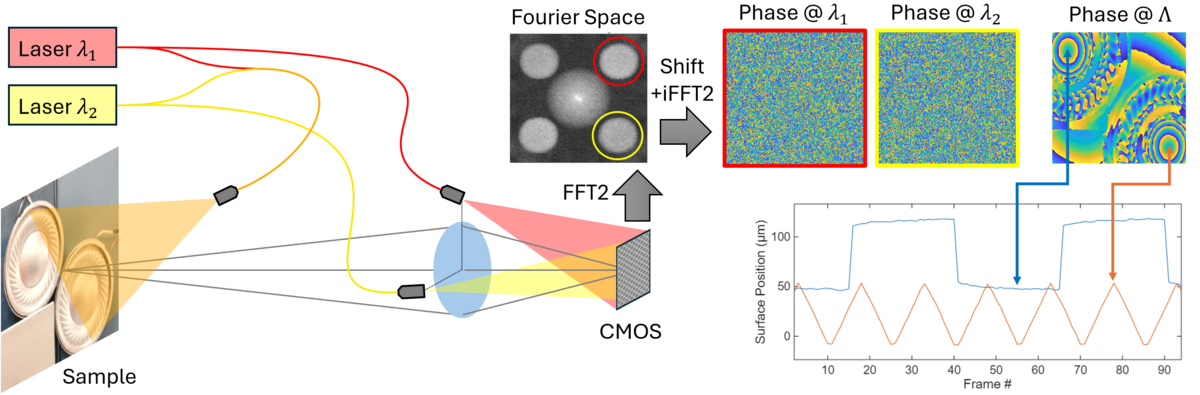
FULL-FIELD VIBRATION MEASUREMENTS USING SINGLE-SHOT SYNTHETIC WAVELENGTH INTERFEROMETRY
Florian Dötzer1, Muralidhar Madabhushi Balaji2, Patrick Cornwall2, Tianyi Wang2, Stefan Sinzinger1, Florian Willomitzer2
1 TU Ilmenau, Department of Mechanical Engineering, Optical Engineering Group, Germany
2 University of Arizona, Wyant College of Optical Sciences, 3DIM Group, USA
Fig. 1. Sketch of the single-shot synthetic wavelength interferometry setup (left), essential interferogram processing steps (top right) and an example of two vibration signals extracted from the same sequence of interferograms (bottom right).
[1] M. Ballester, H. Wang, J. Li, O. Cossairt, and F. Willomitzer, “Single-shot synthetic wavelength imaging: Sub-mm precision ToF sensing with conventional CMOS sensors,” Optics and Lasers in Engineering, vol. 178, p. 108165, Mar. 2024, doi: 10.1016/j.optlaseng.2024.108165.