
Silicon–germanium (SiGe) alloys exhibit strong potential for the fabrication of radiation-tolerant detectors intended for high-energy physics experiments, advanced medical diagnostics, and space applications. Despite their importance, the formation of radiation defects in p-type SiGe structures have not been fully explored, thus, analyzing how these defects can be manipulated or removed using methods such as current injection, annealing, etc. is remarkable for enhancing the durability of next-generation detectors [1].
This work investigates the effects of direct current injection on radiation-induced defects in p-type silicon (Si) and silicon–germanium (SiGe) diodes. The aim of the study is to determine changes in metastable and bistable defects induced by direct current injection in irradiated detectors using deep-level transient spectroscopy (DLTS). Si diodes grown by the Czochralski and epitaxial methods, as well as SiGe diodes containing 1% and 5% Ge, were irradiated with electrons and alpha particles.
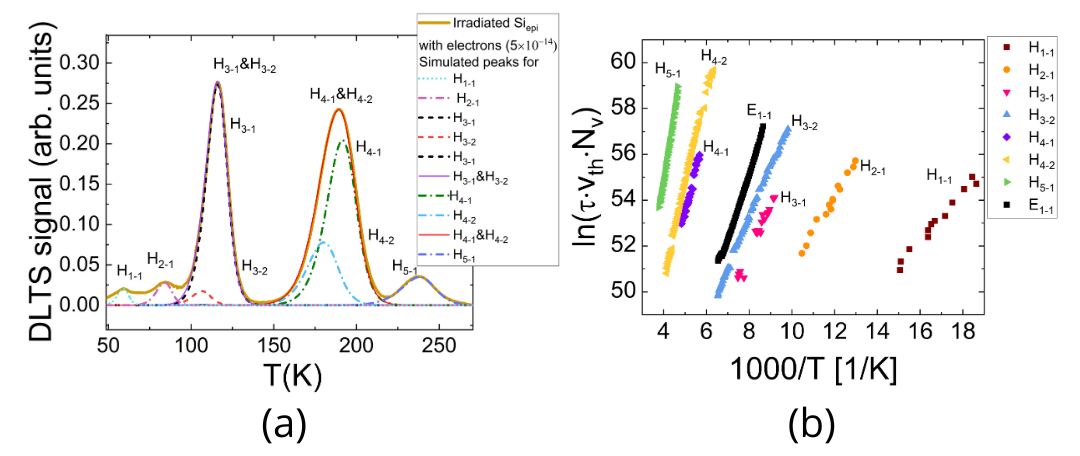
The experimental results demonstrate that direct current injection promotes the transformation of divacancy (V₂) defects into trivacancy (V₃) defects [2] and leads to an approximately twofold increase in the concentration of complexes involving two interstitial atoms and oxygen (I₂O). These findings provide insights into defect transformations induced by current in irradiated semiconductor materials and will be presented at the conference.