
Low Gain Avalanche Detectors (LGADs) are silicon sensors featuring internal signal amplification and are widely used in High-Energy Physics (HEP) experiments, particularly for precise timing measurements in environments with high particle fluences, such as those at Large Hadron Collider (LHC) at CERN. Conventional p-type LGADs have been optimized for the detection of highly penetrating particles but exhibit reduced gain performance for low penetrating radiation [1]. To address this limitation, n-type Low Gain Avalanche Detectors (nLGADs) have been developed to enhance sensitivity to low penetrating particles in silicon, such as soft X-rays, ultraviolet and visible photons, and low-energy charged particles [2]. Due to electron-initiated avalanche multiplication, nLGADs exhibit enhanced gain for surface-near energy deposition, making them particularly attractive for applications in medical physics, including ion beam cancer therapy, where accurate detection of low-energy charged particles is required [3]. However, the performance of nLGADs can be significantly affected by ionizing radiation through mechanisms such as donor removal, gain suppression, and modifications of the internal electric field [4].
In this work, we present an ongoing investigation of the effects of ion-beam irradiation on the electrical properties of novel n-type LGAD devices fabricated at the Instituto de Microelectrónica de Barcelona (IMB-CNM). A systematic irradiation campaign is combined with pre- and post-irradiation electrical characterization, including current–voltage (I–V) and capacitance–voltage (C–V) measurements, to study changes in leakage current, depletion region behavior, and gain-related parameters. The Transient Current Technique (TCT) is used to further investigate irradiation-induced modifications in charge collection efficiency and gain degradation.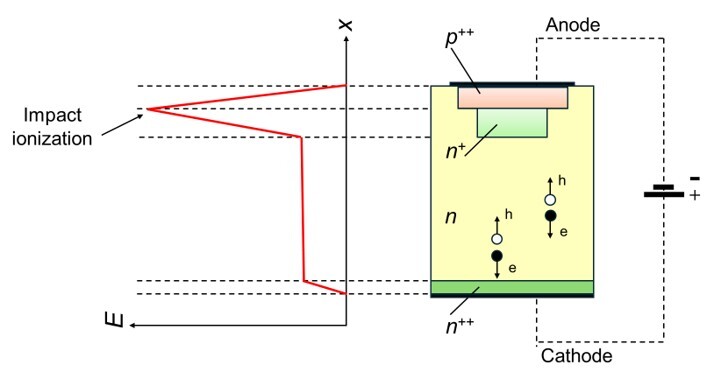
INVESTIGATION OF ION-BEAM IRRADIATION EFFECTS ON THE ELECTRICAL PROPERTIES OF NOVEL N-TYPE LOW GAIN AVALANCHE DETECTORS
Margarita Biveinytė1, Tomas Čeponis1, Laimonas Deveikis1, Miloš Manojlović2, Vytautas Rumbauskas1, Kęstutis Žilinskas1
1 Vilnius University, Institute of Photonics and Nanotechnology, Lithuania
2 Centro Nacional de Microelectrónica, IMB-CNM-CSIC, Cerdanyola del Vallès, Spain
[1] V. Kraus, M. F. Garcia, S. Hidalgo, M. Moll, and J. Villegas, “Studies on the effect of low-fluence proton and neutron irradiation on n-type LGADs,” Nucl. Instrum. Methods Phys. Res., Sect. A, vol. 1083, Art. no. 171138, Nov. 2025
[2] J. Villegas, N. Moffat, D. Maneuski, O. Ferrer, G. Pellegrini, and S. Hidalgo, “Gain measurements on NLGAD detectors,” Nucl. Instrum. Methods Phys. Res., Sect. A, vol. 1055, Art. no. 168377, Jun. 2023
[3] M. Manojlović et al., “Gain response and ion beam-induced donor removal in NLGAD detector: Global gain quenching,” IEEE Sensors J., vol. 25, no. 24, pp. 43985–43996, Oct. 2025
[4] V. Kraus, M. Biveinyte et al., “Investigating irradiation effects and space charge sign inversion in n-type low gain avalanche detectors,” Nucl. Instrum. Methods Phys. Res., Sect. A, vol. 1080, Art. no. 170763, Jun. 2025