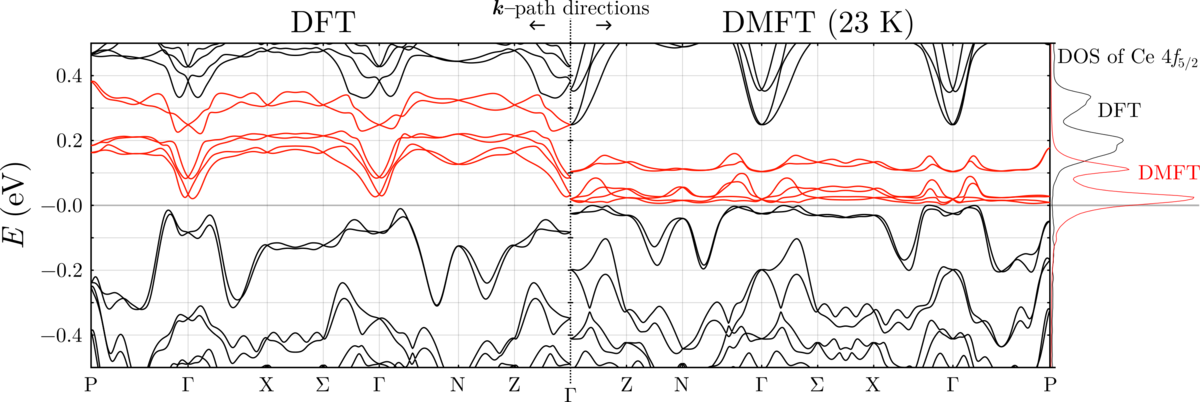
Strongly correlated materials provide a platform for emergent quantum phases [1], including heavy-fermion metals, Kondo insulators, and unconventional superconductors. These phases arise from the interplay between crystal symmetries and complex many-body effects. Describing them from first principles is particularly challenging, as conventional density functional theory (DFT) fails to capture the low-energy quasiparticle physics. Here, using state of the art DFT combined with dynamical mean-field theory (DFT+DMFT) [2], we investigate the \(f\)-electron heavy-fermion compound CeRu\(_{4}\)Sn\(_{6}\) to resolve its electronic structure and topology.
Our calculations show that Kondo hybridization opens a direct gap in the electronic structure, which is bridged by topological band crossings (Weyl nodes) along low-symmetry directions. We identify five inequivalent Weyl nodes of both type-I and type-II, generating a total of \(64\) symmetry-related Weyl points. A comprehensive analysis of these correlation-driven Weyl features is presented in our recent work [3]. The Weyl nodes emerge within correlated quasiparticle bands mainly composed of Ce-\(4f\) orbitals and exhibit small electron velocities close to the Weyl nodes (below \(10\) km/s). The nodes closest to the Fermi energy lie approximately \(0.5\) meV below \(E_\mathrm{F}\), placing the Weyl physics at experimentally accessible energy scales.
These ab initio results establish CeRu\(_{4}\)Sn\(_{6}\) as a model system for correlation-driven Weyl physics in f-electron materials, highlighting the importance of many-body correlations in CeRu\(_{4}\)Sn\(_{6}\) and heavy-fermion systems in general. More broadly, this work provides a foundation for understanding interaction-driven topological phases and quantum transport phenomena in correlated quantum materials.