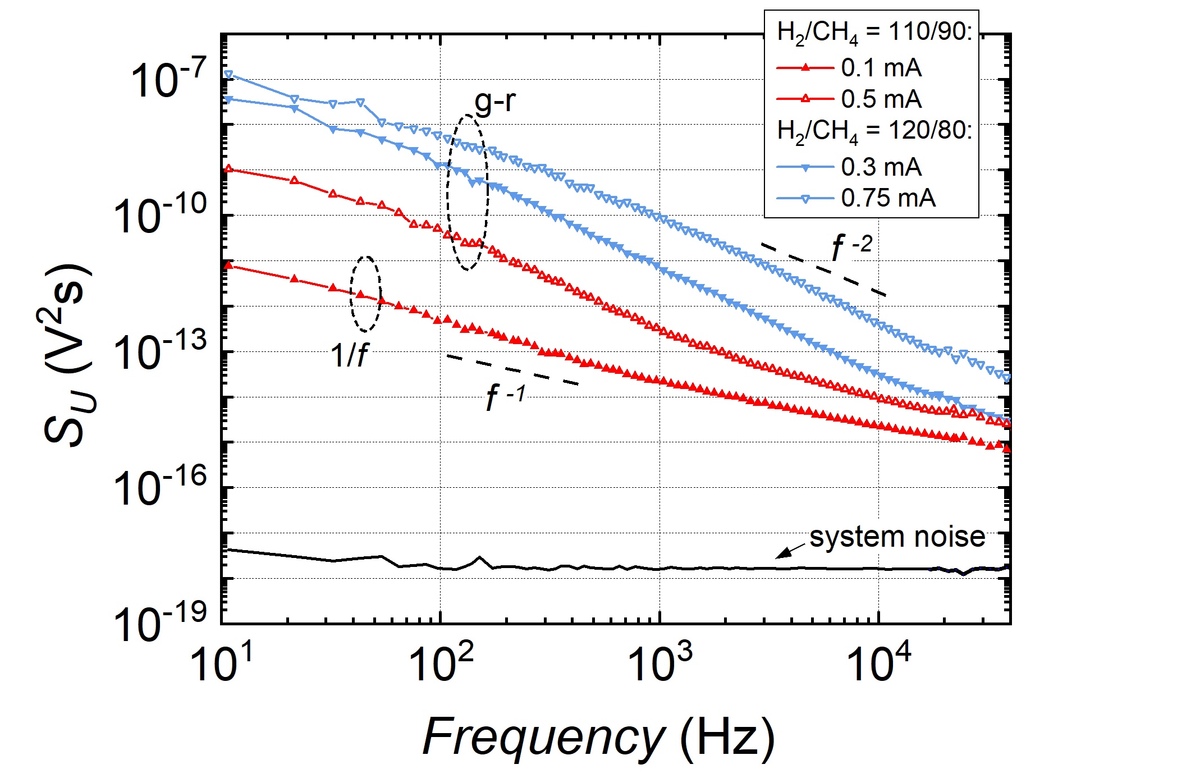
Graphene/Si junctions have attracted considerable interest for electronic and optoelectronic applications due to the combination of graphene’s high carrier mobility and optical transparency with silicon’s well-established fabrication technology. Direct and catalyst-free growth of both pristine and hydrogenated graphene is possible by plasma-enhanced chemical vapor deposition (PECVD). However, hydrogenated graphene can be deposited at significantly lower temperatures [1]. Moreover, hydrogenation partially opens a bandgap, enabling interface passivation and reducing dark current, making hydrogenated graphene/Si heterostructures promising for high-performance Schottky photodetectors and sensors [2]. Low-frequency noise measurements are a sensitive and non-destructive way to assess device quality and reliability, and to gain insight into underlying physical mechanisms. To date, no scientific reports have been found in the literature on the low-frequency noise characteristics of hydrogenated graphene or devices based on it. The aim of this work was to investigate the low-frequency noise characteristics of hydrogenated graphene/Si junctions and to evaluate the influence of different graphene synthesis conditions, used during the same low-temperature PECVD growth of graphene, on the observed noise behaviour.
Electrical noise measurements were performed in the 10 Hz – 60 kHz frequency range under forward and reverse bias in a wide temperature range. Depending on the different synthesis conditions used during graphene’s growth, the junctions exhibited 1/f, Lorentzian (g-r), or both types of voltage noise spectra (Fig. 1). For samples that exhibited pronounced Lorentzian-type spectral components, temperature dependent noise spectroscopy was performed in order to find the charge carrier characteristic time and activation energy of the observed g-r processes, which was compared with the theoretically calculated value in [3]. Statistical analysis across multiple junctions of the same synthesis conditions samples revealed the highest noise intensity in samples where graphene was synthesized with the highest H\(_2\)/CH\(_4\) flow ratio at the same low temperature.