
The discovery of thousands of exoplanets in recent years has fundamentally revolutionized our understanding of planet formation and their evolution. Thanks to space missions like Kepler & Transiting Exoplanet Survey Satellite, and ground-based telescopes, more than 6 000 exoplanets have been confirmed so far. Understanding the chemical composition of stars hosting exoplanets is crucial for understanding the formation and evolution of planetary systems. High-resolution spectroscopy offers a powerful tool to probe the elemental abundances in these stars, shedding light on the conditions under which planets form and evolve.
In this talk, I present results from a homogeneous, high-resolution spectroscopic analysis of a set of neutron-capture element abundances in a sample of 160 F-, G-, and K-type stars hosting confirmed planets. The targets and planetary parameters were chosen from the confirmed exoplanet list available at the NASA Exoplanet Archive. Observations were carried out with the 1.65-m telescope installed at Molėtai Astronomical Observatory of Vilnius University in Molėtai, Lithuania. The telescope is equipped with a high-resolution Vilnius University Echelle Spectrograph.
The analysis is based on differential line-by-line spectrum synthesis using MARCS model atmospheres, with careful treatment of hyperfine splitting and non-local thermodynamic equilibrium effects for key species. We find that most elemental abundance ratios in planet-hosting stars follow Galactic chemical evolution trends; however, statistically significant overabundances of Zr, La, and Ce are detected in stars with planets when compared to chemically similar non-hosts at a given [Fe/H] (see Fig.1).
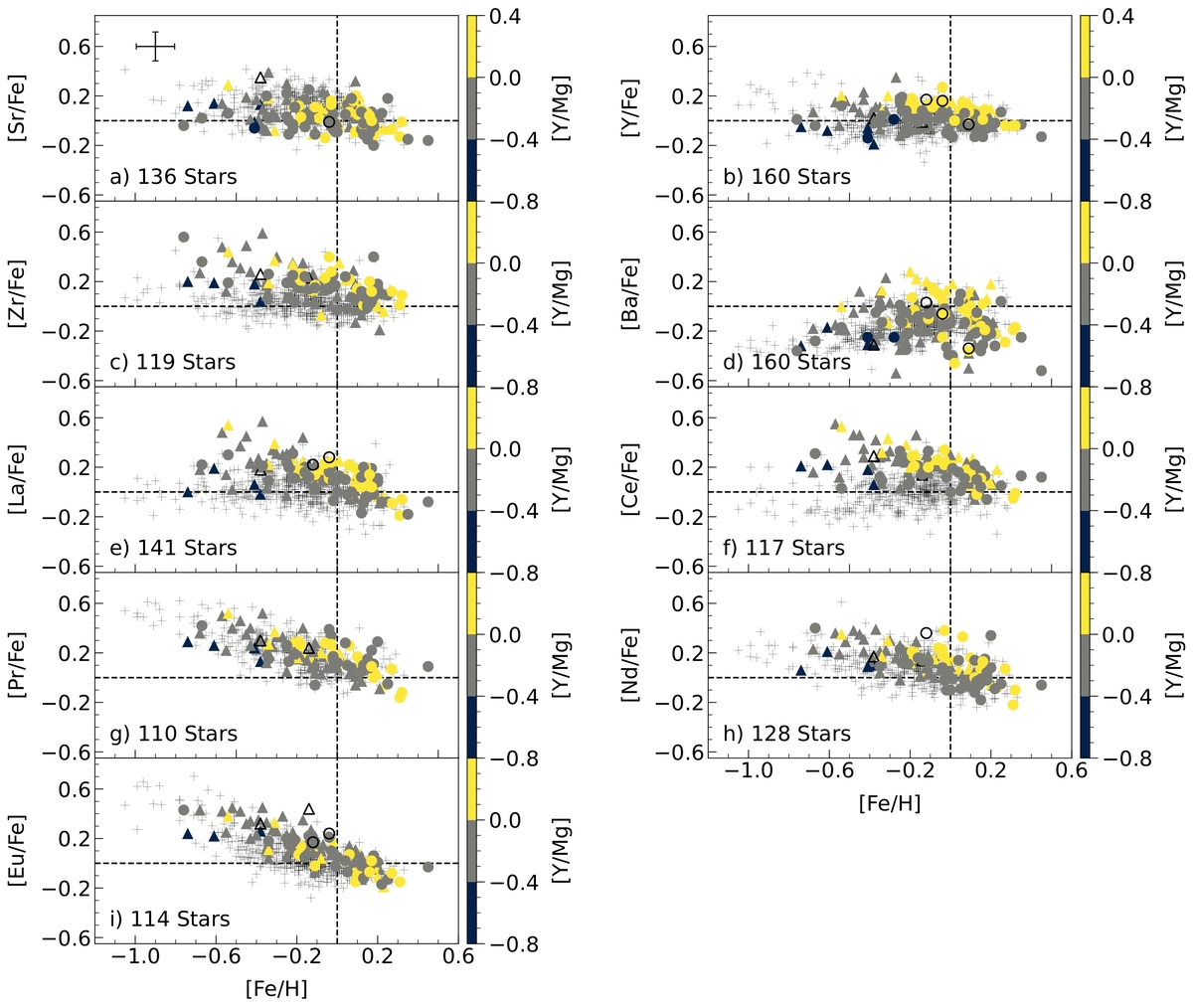
We further explore the connection between stellar chemistry and planetary properties. Several neutron-capture elements exhibit positive correlations with planetary mass, whereas Sr, Y, and Ba show insignificant correlations across all sub-samples. Condensation-temperature trends indicate a systematic enrichment of refractory material in planet-hosting stars. Multi-planet systems are found preferentially around metal-rich stars, and older systems tend to show flatter or negative abundance-condensation temperature slopes, hinting at evolutionary effects in planetary architectures.
Together, these results provide new observational constraints on the role of heavy elements in planet formation and highlight the importance of homogeneous abundance analyses in disentangling chemical evolution from genuine star-planet connections. The findings have direct relevance for current and upcoming exoplanet missions and for models linking stellar nucleosynthesis to planetary system diversity.