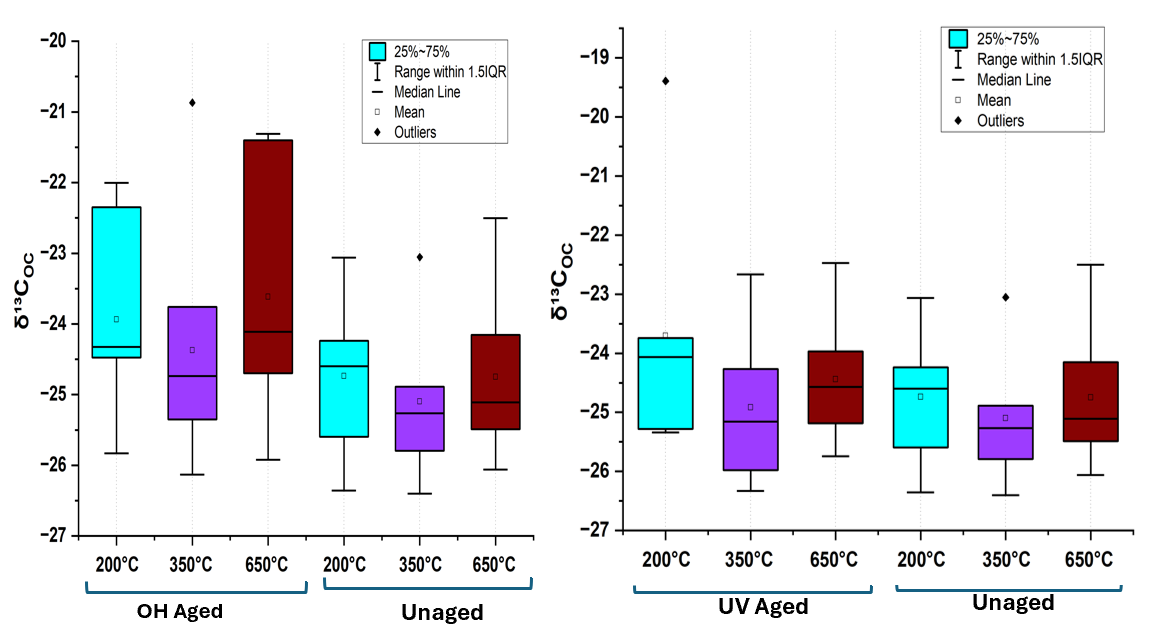
Carbonaceous aerosols from anthropogenic sources, including biomass burning (BB) and vehicular emissions, are a major component of fine particulate matter and play an important role in air quality, climate forcing, and human health [1]. However, uncertainties remain in identifying their sources and understanding how their chemical signatures evolve during atmospheric processing. Stable carbon isotopic composition (δ¹³C) of organic carbon (OC) offers a promising tracer to address these challenges. This study investigates the applicability of δ¹³C in anthropogenic atmospheric pollution research through two independent experimental approaches.
Firstly, laboratory aging experiments were conducted on aerosols produced from the combustion of six different biomass fuels to examine isotopic changes during photochemical processing. δ¹³C of OC was measured across three thermal fractions (200 °C, 350 °C, and 650 °C). OH-aged samples showed minimal isotopic change, in contrast to consistent ¹³C depletion following UV aging. The intermediate-temperature OC fraction (350 °C) was generally enriched in ¹³C compared to other fractions after UV aging. For example, wood-pellet emissions showed δ¹³C values of −25.3 ‰, −25.1 ‰, and −25.0 ‰ for the 200 °C, 350 °C, and 650 °C fractions, respectively, compared to −25.6 ‰, −25.7 ‰, and −25.4 ‰ in un-aged samples.
Secondly, δ¹³C of three-step OC was characterized for vehicle exhaust aerosols(un-aged) collected from eleven in-use vehicles. Substantial variability in isotopic composition was observed among vehicles and thermal fractions, with most values clustering between −26 ‰ and −28 ‰, alongside notable deviations in specific samples.
Overall, the results demonstrate that δ¹³C of OC is sensitive to both photochemical aging and source-specific emission characteristics, supporting its use as a tracer for anthropogenic aerosol source apportionment and atmospheric pollution studies.