Radiation direction finding (DF) is a difficult challenge in the fields of RF and Microwave engineering. It is often used for radar detection and locating unknown transmitters. While DF is not an innovative idea, research into developing simplified systems is an ongoing subject of interest [1]. In this work, a novel DF approach is presented that estimates the angle of arrival by comparing the ratio of measured received powers across circularly mounted antenna array applying the directivity pattern \({\mathit G_{rx} (\alpha) }\) of each antenna in the array.
The Friis equation states that the far–field received signal power depends inversely on the square of the distance between the transmitter and receiver, and it is directly related to the gains of the antennas involved [2]. Assuming differences in distances between the transmitter and the receiving antennas are negligible, signal’s angle of arrival \(\phi\) can be estimated from the ratio of received powers \({\mathit P_{r1}}\) and \({\mathit P_{r2}}\), which equals to the ratio of antenna gains \({\mathit G_{r1}}\) and \({\mathit G_{r2}}\) at the same angle \(\phi\):
\[\cfrac{P_{r1}}{P_{r2}}(\phi) = \cfrac{G_{r1}}{G_{r2}}(\phi)\]
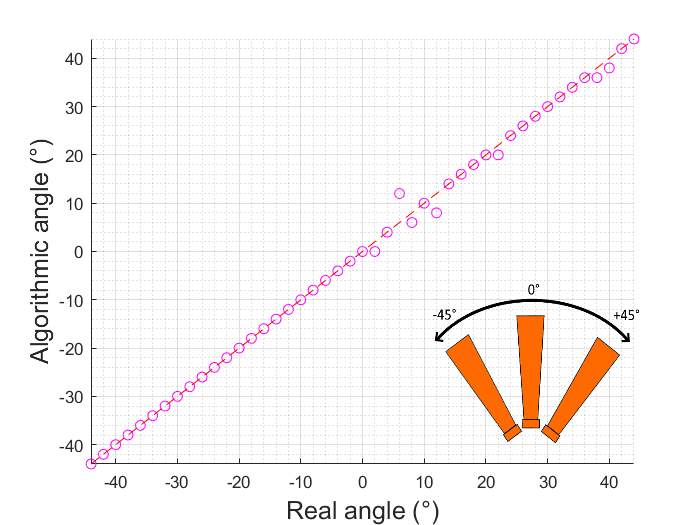
To validate the accuracy of this relationship, measurements using three X–band ( 8 – 12 GHz ) antennas spaced 45° apart were made in a microwave anechoic chamber. An experiment was conducted using a 10 GHz, 0 dBm CW signal while rotating the antennas from −45° to +45° in 2° steps and recording received power. Using eq. 1, an algorithm was developed to estimate angle of arrival by matching antenna gain ratios to received power ratios. Results (Fig. 1) demonstrate that using high-gain antennas enables direction estimation with a maximum error of 6°. Overall, the measured performance verifies the proposed method as an effective and low-complexity approach for DF.