Bioactive room temperature ionic liquids (b-RTILs) are room temperature-molten salts compatible with living organisms. RTILs are becoming more popular in the scientific community due to the high number of ion combinations and tunability. Choline glycinate is one of the b-RTIL. It has potential in medicine, biofilm growth inhibition and in CO\(_{2}\) absorption and separation. One of the most important parameters of ILs is the diffusion coefficient. It can give us information about the size or structure of molecules and how interaction between molecules change in different concentrations.
The main objective is to investigate the diffusion of choline glycinate ([Cho][Gly]) in a water mixture using DOSY and compare with other ionic liquids: choline lysinate ([Cho][Lys]) and choline tryptophanate ([Cho][Trp]). DOSY (Diffusion-Ordered Spectroscopy) is a powerful NMR (Nuclear Magnetic Resonance) tool for measuring the diffusion coefficient of a specific proton. The magnetic field gradient sequence is applied to the sample. With a different magnetic field, we get a different precession frequency. Due to the constant movement of molecules, the intensity of the spectra is lower than with a homogenous magnetic field across the sample. In the experiment, the intensity is measured using different gradient strengths. Using the Stejskal-Tanner equation, the diffusion coefficient can be calculated. The change in the intensity also depends on the size of the molecule and viscosity.
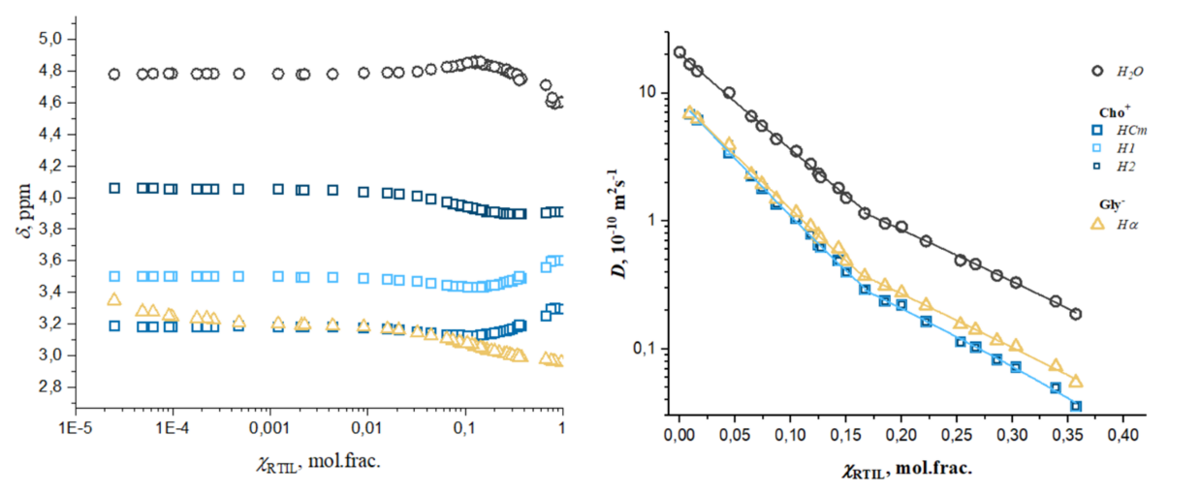
Using the DOSY method, it was found that the diffusion coefficient of a water molecule is the largest. The same can be said with water in [Cho][Lys] and [Cho][Trp] water mixtures. Also, there are two diffusion regimes in [Cho][Gly]: H\(_{2}\)O in choline glycinate and choline glycinate in H\(_{2}\)O. The breaking point is observed at χ\(_{RTIL}\)=0.16 mol.frac. concentration. Almost the same concentration as \(^{1}\)H chemical shift minima of chemical groups around choline’s nitrogen nucleus and \(^{1}\)H chemical shift maxima of water. The breaking point can also be seen in [Cho][Lys] and water mixture, but at a lower concentration at around χ\(_{RTIL}\)=0.11 mol.frac. The occurrence of two separate regimes is due to strong hydrogen and Coulombic bonds between choline and glycine anion, and water’s ability to break those bonds and form hydrogen bonds with those ions. At high water concentration, the cation’s and anion’s diffusion coefficients converge to one value. It can be due to anion self-aggregation.