X-BAND BIMODAL MICROWAVE CAVITY FOR EPR SPECTROSCOPY
Ignas Pocius1, Vidmantas Kalendra1, Jūras Banys1, Mantas Šimėnas1
1 Vilnius University, Faculty of Physics, Institute of Applied Electrodynamics and Telecommunications, Lithuania
Electron paramagnetic resonance (EPR) spectroscopy is a widely used technique for studying paramagnetic centres in materials ranging from solids to proteins [1]. The method is based on the quantum nature of the electron spin, which causes splitting of its energy levels in the magnetic field. The essence of EPR spectroscopy is the excitation of the quantum transitions between these levels and the detection of the microwave absorption using microwave resonators [2].
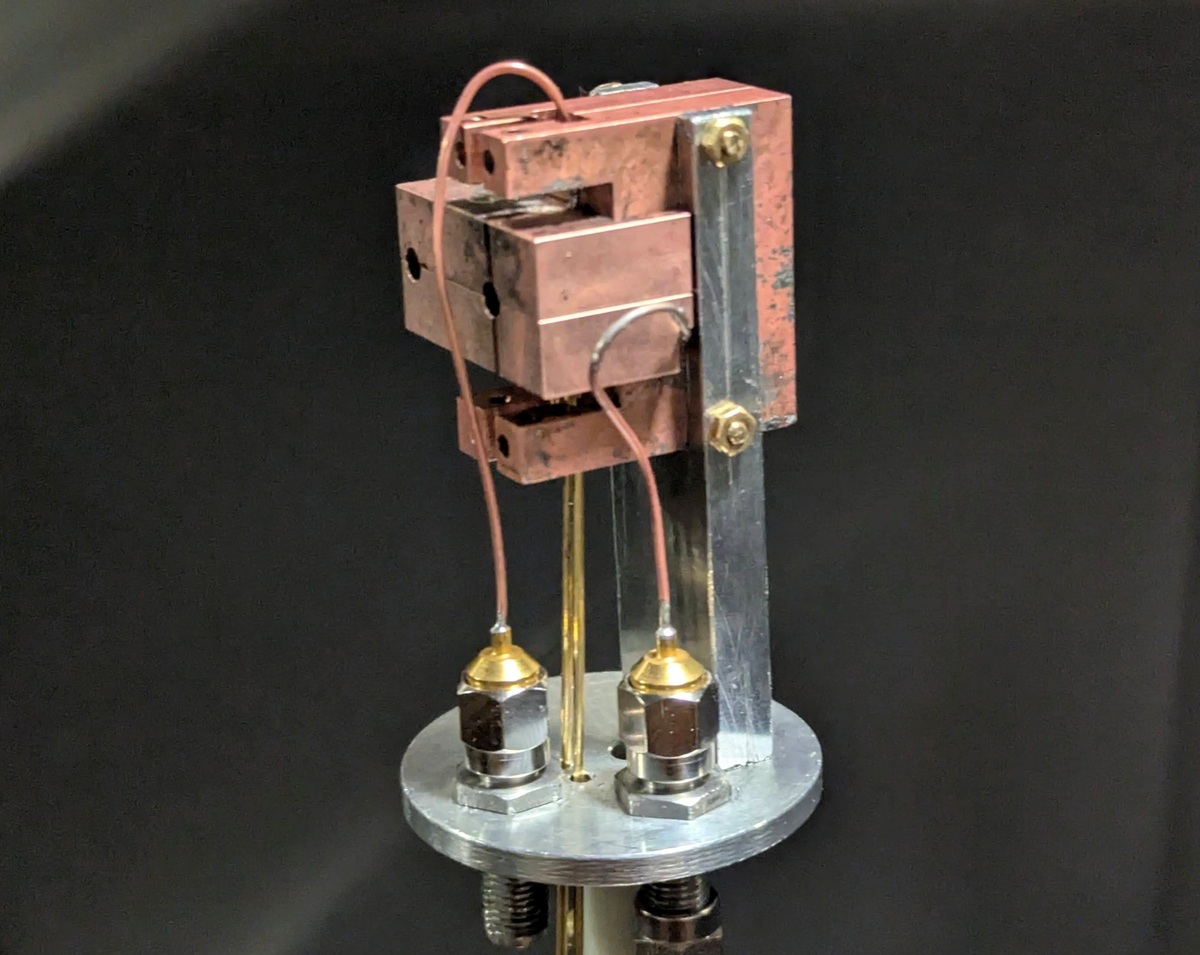
Here, design and characterization of a microwave resonator with two orthogonal modes, which was modelled and manufactured based on the design proposed in Ref. [3] (see Figure 1) is presented. In such bimodal microwave resonators, one of the modes excites the spins in the sample, while the other mode is used to read out the EPR signal. In addition, this resonator geometry prevents the resonator ringing effect [3-5] and can be used to suppress thermal microwave noise greatly enhancing EPR sensitivity.
Fig. 1. Manufactured bimodal microwave resonator with tuning screws and microwave antennas.
[1] A. Lund, M. Shiotani, and S. Shimada, Principles and applications of ESR spectroscopy. Springer Netherlands, 2011.
[2] J. A. Weil and J. R. Bolton, Electron Paramagnetic Resonance: Elementary Theory and Practical Applications, 2nd ed. Hoboken, NJ, USA: John Wiley & Sons, 2007.
[3] G. A. Rinard, R. W. Quine, J. McPeak, L. Buchanan, S. S. Eaton, and G. R. Eaton, “An X-Band Crossed-Loop EPR Resonator,” Applied Magnetic Resonance, vol. 48, no. 11–12, pp. 1219–1226, Dec. 2017.
[4] G. A. Rinard, R. W. Quine, B. T. Ghim, S. S. Eaton, and G. R. Eaton, “Easily Tunable Crossed-Loop (Bimodal) EPR Resonator,” J. Magn. Reson., Ser. A, vol. 122, no. 1, pp. 50–57, Sep. 1996.
[5] C. Mailer, H. Thomann, B. H. Robinson, and L. R. Dalton, “Crossed TM110 bimodal cavity for measurement of dispersion electron paramagnetic resonance and saturation transfer electron paramagnetic resonance signals for biological materials,” Review of Scientific Instruments, vol. 51, no. 12, pp. 1714–1721, 1980.