Charge separation in non-fullerene organic solar cells (OSCs) is widely regarded as a central yet unresolved process, with ongoing debate over whether it is primaraly governed by thermally activated processes to overcome Coulombic binding or proceeds via a barrier-free, coherence-driven mechanisms. Resolving this question is essential for optimizing charge generation efficiency, suppressing recombination losses, and improving overall device performance. In this study, a temperature-dependent investigation of charge separation dynamics is presented for the three donor–acceptor blends exhibiting different highest occupied molecular orbital (HOMO) level offsets. Ultrafast transient absorption spectroscopy, combined with multivariate curve resolution analysis, was employed over a broad temperature range (50–350 K) to directly monitor the formation of charge-transfer and spatially separated charge states.
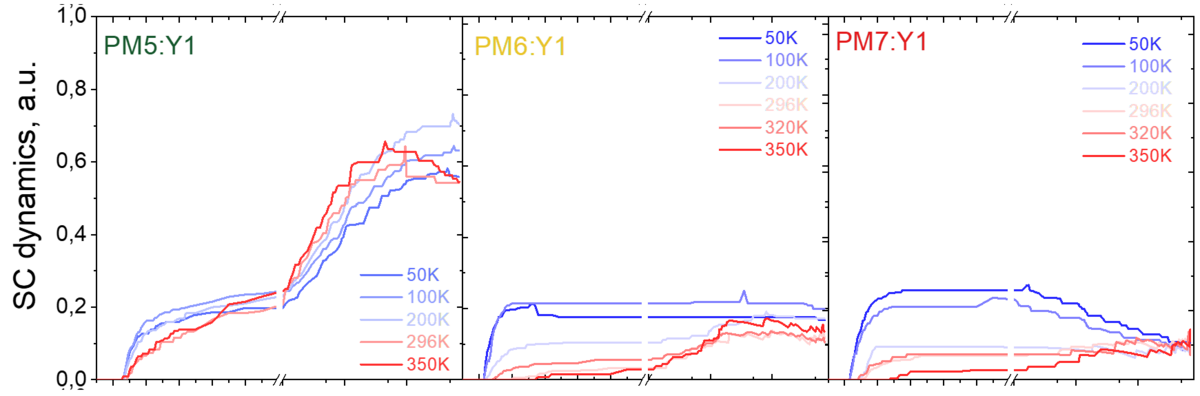
Accelerated charge separation was observed at lower temperatures for all investigated blends, contrary to expectations for thermally activated processes. At cryogenic temperatures, an ultrafast separation channel was found to dominate, whereas at elevated temperatures this this channel was progressively suppressed and replaced by slower, thermally activated charge separation, occurring on hundreds-of-picoseconds timescales. The enhanced low-temperature behavior in this work is attributed to reduced thermal disorder, by which electronic coherence and charge delocalization are preserved, enabling rapid escape from Coulombic attraction prior to charge localization.
These findings provide direct experimental evidence for non-relaxed, coherence-assisted charge separation in non-fullerene OSCs and reveal a temperature-driven crossover between coherent and thermally activated pathways. In doing so, previously conflicting models of charge separation are reconciled, offering new design principles for high-efficiency organic photovoltaic materials and devices.