X-ray radiation is widely used in modern medicine, industry, and science. With the rising demand for sub-picosecond pulses, laser–plasma interaction has emerged as a compact alternative to large-scale accelerator facilities. In this process, a femtosecond laser pulse ionizes the target, creating plasma in which electrons are accelerated by the electromagnetic field. These electrons subsequently re-enter the target, producing bremsstrahlung and characteristic X-ray radiation.
In this study, X-ray generation from a copper target using 1 μm and 2 μm femtosecond laser systems was investigated. A femtosecond laser system “Pharos PH1-SP-1.5mJ” with center wavelength λ = 1028 nm and pulse duration τ = 158 fs, as well as an optical parametric amplifier (OPA) ORPHEUS MIR (“Light Conversion”) with a tunable wavelength range from 1300 nm to 11000 nm, were employed. The OPA was operated at a center wavelength of λ = 2000 nm with a pulse duration of τ = 36 fs. In both cases, the pulse energy was E\(_{p}\) = 0.135 mJ and the repetition rate was f = 4 kHz, resulting in an average laser power of P = 540 mW. X-ray emission was detected using a thermoelectrically cooled Si-PIN spectrometer Amptek X-123. Measurements were performed in reflection geometry, with the detector placed 150 mm from the target at angles ranging from 30\(^{\circ}\) to 90\(^{\circ}\) relative to the incident laser beam.
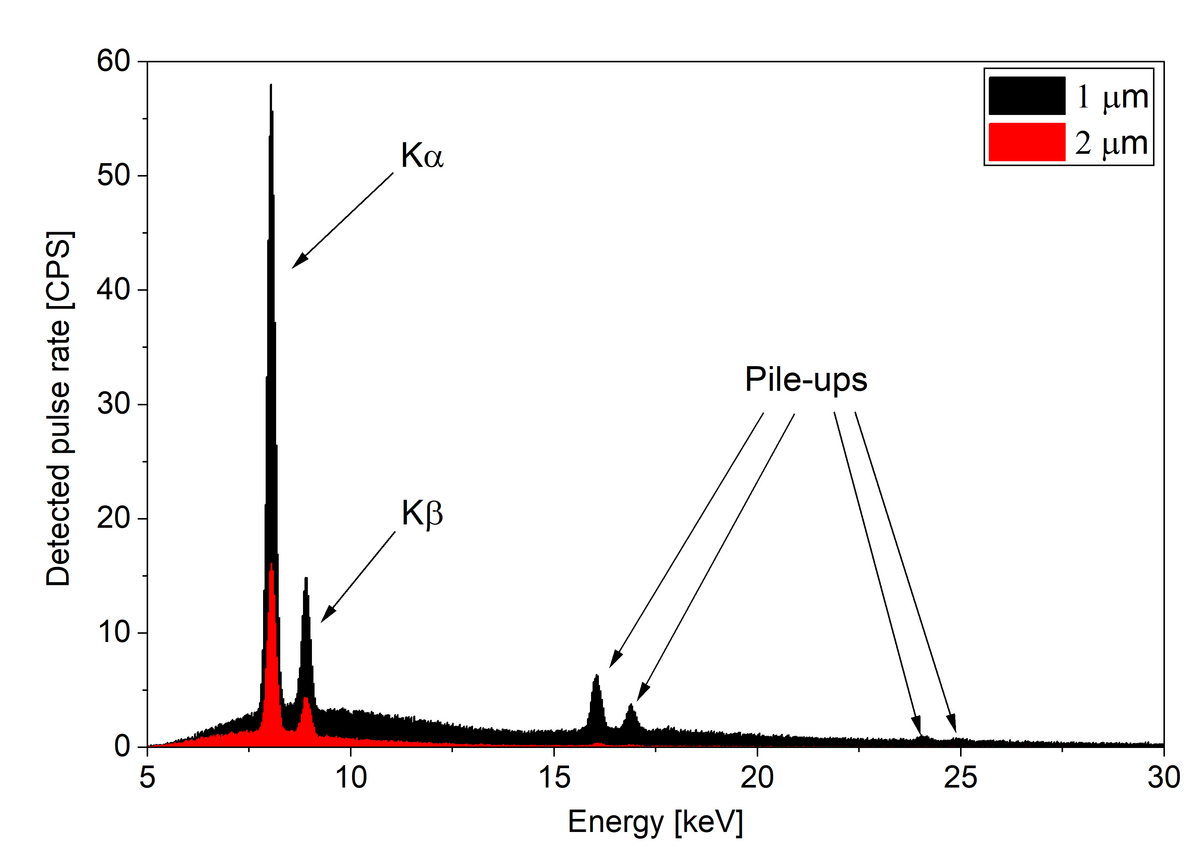
According to the literature, longer-wavelength laser radiation can enable more efficient X-ray generation due to the scaling law \(I\lambda^{2}\)[1]. Fig. 1 shows the copper X-ray spectra obtained using described laser systems. The characteristic Kα (8.04 keV) and Kβ (8.96 keV) emission lines, bremsstrahlung background, and pile-up effects are clearly observed. Contrary to expectations, the experimental results demonstrate a several-fold higher X-ray photon yield for the 1 µm laser. These findings are inconsistent with previously reported data [2]. For longer wavelengths, electrons interact with the plasma over a longer time, penetrate deeper into the target, and may be partially screened, resulting in reduced X-ray generation efficiency. Compensation for this effect requires higher laser pulse energies.